One of the most helpful things I’ve learned from the Simeon Trust workshops is how to find the melodic line in a book of the Bible. As a Bible nerd, I love digging into the details of a passage, pursuing cross references and doing word studies, but hadn’t considered the value of looking at a book as a whole unit. What is the main theme of a book? How does that guide us as we dig deeper?
As a musician, this concept also appealed to me because it was taught using the illustration of a music staff, like this:
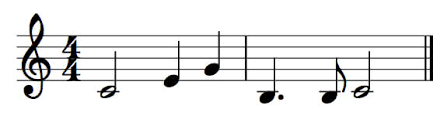
If you don’t read music, most of these notes are a different pitch and different lengths. Each music note is supposed to represent a key component of the book of the Bible. It could be a repeated word or phrase. It could be the way the book is structured. Your job is to find these notes and examine how they relate to one another. Which ones are more important? Which ones are instrumental (pardon the pun) in developing the theme? But how do you do this? Here are some strategies that I have used in studying Revelation.
Read and Reread
Repetitive reading is a highly underused Bible study skill. One of the reasons for this is because we have all been conditioned by our culture and technology to read in a way that is fast and reductive. We want to get to the point and right now! This creates readers who skim on top of the surface of the text instead of deep divers who go below to explore the depths. Slowing down and taking the time to read a passage over and over again helps you notice things.
Listen
I used to think that listening to a book didn’t count. I still prefer reading silently over listening to someone read aloud, if only to be able to control my pace, but listening is how most Christians took in the book of Revelation until only a few hundred years ago. People just didn’t have access or were not literate. How blessed are we to have so many options! Let’s take advantage of them. One of the main benefits I have found in listening to Revelation is catching the tone of the book. Every book has a certain tone, mood, or if we’re talking music, a key signature. The book may start in a minor key (sad, dark, or ominous) but then modulate to major (happy and peaceful resolution). Lament psalms often do this. In my many trips over to South Carolina to help my parents, I have taken advantage of that 3-4 hour drive (depending on Atlanta traffic!) to listen to Revelation straight through multiple times.
Epic.
That is the first word that came to mind when I thought about the tone of this book. It is a grand and monumental story that sweeps the reader up into visions of worship and judgment, an enemy dragon and a redeeming Lamb that was slain but is standing! There are dire warnings but also wonderful assurances of reward for those who conquer. If I had to choose a composer to write the soundtrack of Revelation it wouldn’t be Mozart. It would be Mahler. This book is meant to move us.
Repeated Words
As I read through the book I began noticing all the repeated words and phrases. This is a prophetic vision given to John so the words saw, looked, heard, and show are repeated over and over, more than 70 times! This helps us understand the kind of book this is. It is not a historical narrative that John retells in chronological order. He is showing us in highly symbolic language different pictures of the same period of time between Christ’s first and second comings. And what image is at the controlling center? This gets to another repeated word – throne. This word is repeated over 40 times in the book, especially in chapters 4 and 5. After the letters to the seven churches and before the cycles of judgment begin with the opening of the seven seals, John is whisked up into the heavenly throne room of God. Why? God wants him to know and his readers to know that whatever happens in this book, the Lord is in control. He is worthy and he reigns over it all.
Speaking of sevens, that word occurs over 50 times in the book. Numbers play a big role in Revelation and none more importantly than the number seven. Seven is the number of wholeness and completion. It is fitting that the book that brings every theme and every promise of the story of Scripture to fulfillment contains so many sevens. This is a book about ultimate consummation.
Top and Tail
Top and tail is a strategy that looks at the beginning and end of a book to see any parallelisms. If an author begins and ends by repeating similar words or phrases or repeating a purpose statement, that gives us a clue as to what the author is wanting his reader to focus on.
If we compare the beginning and end of Revelation we see a few things highlighted:
- Christ is the central focus as the Alpha and Omega, the beginning and the end.
- The message is given to show what must soon take place – Jesus is coming!
- There is a blessing for those who keep the message of this book.
The purpose statement of the book is also repeated at the beginning and end. In Revelation 1:1-3 and 22:6 we read that the Lord has sent his angel to make known to his servants what must soon take place. This book is an unveiling, a revealing, not a puzzle to unlock with a secret decoder ring.
What then?
There are several other strategies I used to help find the melodic line, but for now let’s take what I’ve mentioned above and try to put it together. One thing to remember is that this melodic line is tentative and open to refinement. As you go along in deeper study, you will see things that you’ve missed and you’ll want to adjust your melodic line. But doing this before getting into that deeper study, will give you a strong sense of what the author is trying to communicate. It will also keep you on track. If you come up with an interpretation that clashes with the main purpose of the book, you may want to rethink that interpretation.
If you explore the Simeon Trust website you’ll find a wealth of resources there including audio recordings of past workshops. I pulled one up on Revelation and heard the speaker guide some pastors in coming up with a tentative melodic line. Here are two ideas they came up with:
- “Blessed is the one who keeps his words for Jesus is coming soon.”
- “Jesus is coming soon and will reward those who endure.”
Notice how they both include the main event the book is pointing toward – Jesus’ second coming. They also include the ideas of blessing and endurance. What’s important is that you include words from the text in your melodic line so that it carries the identity of the book. If you make your melodic line too general it could apply to several different books. Your melodic line for Revelation should carry with it the distinct flavor of this book.
What did I come up with? It’s still tentative and probably needs to be edited, but my first stab at a melodic line for Revelation is this:
Blessed are those who patiently endure in the testimony of Jesus, for the Lamb has conquered and is coming soon to judge his enemies and usher his bride into the New Jerusalem.
In doing this exercise, I am a lot less confused about how to approach this book. I am able to see the overarching purpose and themes that God wants his people to see. And that fills me with excitement as I get into deeper study.
Has this helped you understand Revelation better? How can you use this concept of a melodic line in your own Bible study?
 Women Studying the Word