In December of 2023 I went on a mission trip to Guatemala and was gone for about ten days. When I came back I learned that my husband had binge watched every season of The Chosen while I was gone and he was eager to have me watch the series with him. For the next couple months we made our way through each episode and had a lot of fruitful discussion. It’s undeniable that a lot of care has gone into the production of this series. But it’s also obvious, at least for those with a modicum of Bible literacy, that they’ve taken some liberties in how they’ve presented the gospel stories.
When the series first premiered and became popular I was very hesitant to watch. I read glowing reviews from people who said the series made the Bible come alive for them and really encouraged them in their faith. But I had questions. Shouldn’t the Scripture be sufficient in revealing to us who God is? God could have decided to wait and send his Son into the world at a time after video technology had been invented. But he didn’t. Some were educated enough to read and write but many were not. Isn’t there a reason why Jesus is called “The Word”? God’s special revelation came to us in a person and in a book, not a TV show. And what would happen if I watched the show and then my own Bible reading was unduly influenced by pictures of Jonathan Roumie in my head? My husband would counter and say that we all use our imaginations when we read the gospels. But what about the second commandment in Exodus 20 which forbids us from making an image of anything and worshiping it as God?
There are many questions to consider (and if you’d like to read some very good reflections on it and the role of the Christian conscience I recommend going here), but for this post I’d like to think about the pictures Scripture gives us of Christ, specifically in the book of Revelation.
At the incarnation, the second person of the Trinity assumed a human nature, but we are not told very much about his appearance. One description that comes close is in Isaiah 53:2-3: “For he grew up before him like a young plant, and like a root out of dry ground; he had no form or majesty that we should look at him, and no beauty that we should desire him. He was despised and rejected by men, a man of sorrows and acquainted with grief; and as one from whom men hide their faces he was despised, and we esteemed him not.” This is not an particularly attractive picture but we must also balance it with what Luke reports in Luke 2:52: “And Jesus increased in wisdom and in stature and in favor with God and man.” While we cannot know for sure, Jesus the man was probably plain looking but enjoyed the favor of both his Father and the people around him. For a while he had a good reputation.
But we must always remember that the second person of the Trinity is both God and man and that forever. There is a lot of mystery here for sure, but we do know from the Scriptures that Christ’s assumption of a human nature continues forever. His physical body was raised from the grave and he is at the right hand of the Father interceding for us as one person with two natures. If that seems confusing to you, join the club, because it’s one of the most difficult doctrines in the Christian faith. If you want help going deeper though, I suggest you go here for a concise primer on what theologians call the hypostatic union.
With that said, let’s move on to Revelation. My point here is to get you thinking about what you think about when you read the descriptions of Christ in this last book of the Bible. Because it’s easy for us to slide into an unbalanced view of Christ, especially if we’ve been unduly influenced by productions like The Chosen, The Passion of the Christ or even if we’re in the stage of life where we’re spending a lot of time reading children’s Bibles to our kids.
Let’s focus on three different pictures of Christ – the glorious Son of Man in Revelation 1, the Lamb standing as if slain in Revelation 5 and the rider on the white horse in Revelation 19. What is your mind doing as you read these descriptions?
Revelation 1:12-16 says:
Then I turned to see the voice that was speaking to me, and on turning I saw seven golden lampstands, and in the midst of the lampstands one like a son of man, clothed with a long robe and with a golden sash around his chest. The hairs of his head were white, like white wool, like snow. His eyes were like a flame of fire, his feet were like burnished bronze, refined in a furnace, and his voice was like the roar of many water. In his right hand he held seven stars, from his mouth came a sharp two-edged sword, and his face was like the sun shining in full strength.
Next, Revelation 5:5-7 says,
And one of the elders said to me, “Weep no more; behold, the Lion of the tribe of Judah, the Root of David, has conquered, so that he can open the scroll and its seven seals.” And between the throne and the four living creatures and among the elders I saw a Lamb standing, as though it had been slain, with seven horns and with seven eyes, which are the seven spirits of God sent out into all the earth. And he went and took the scroll from the right hand of him who was seated on the throne.
Finally, read Revelation 19:11-16:
Then I saw heaven opened, and behold, a white horse! The one sitting on it is called Faithful and True, and in righteousness he judges and makes war. His eyes are like a flame of fire, and on his head are many diadems, and he has a name written that no one knows but himself. He is clothed in a robe dipped in blood, and the by which he is called is The Word of God. And the armies of heaven, arrayed in fine linen, white and pure, were following him on white horses. From his mouth comes a sharp sword with which to strike down the nations, and he will rule them with a rod of iron. He will tread the winepress of the fury of the wrath of God the Almighty. On his robe and on his thigh he has a name written, King of kings and Lord of lords.
One of the many reasons God forbade the Israelites from making images is because they necessarily diminish God and bring him down to our size. Images of God lie to us, telling us that he is someone we can control. When we try to picture something or someone we’re attempting to understand and that’s not always a bad thing but on the flipside, that picture tempts us to think we have grasped that thing or person, that we have some level of control over it.
While there is true comfort in reading the gospels and knowing that the second person of the Trinity, the very Son of God, walked among us and ate and talked with us, healed us and touched us, there is more to him. The disciples saw that on the Mount of Transfiguration, they realized it when he appeared to them out of nowhere following his resurrection and when he ascended into heaven before Pentecost. And here in Revelation, John sees visions of Christ that he can hardly describe in words so he uses pictures that his readers could relate to. But these pictures were never meant to be hung on the wall, but to bring us to our knees in worship, realizing that Christ is far more glorious than we could have ever imagined. Each of these visions of Christ is meant to remind his readers of the whole story of Scripture and help them connect the dots from Daniel’s Son of Man, and the lambs that were slain on Passover, and the images of God as a victorious warrior from the prophets.
My father-in-law had a framed picture of Christ hanging in his home for years. He always hung it near the door and it was very precious to him. It looked a lot like this:
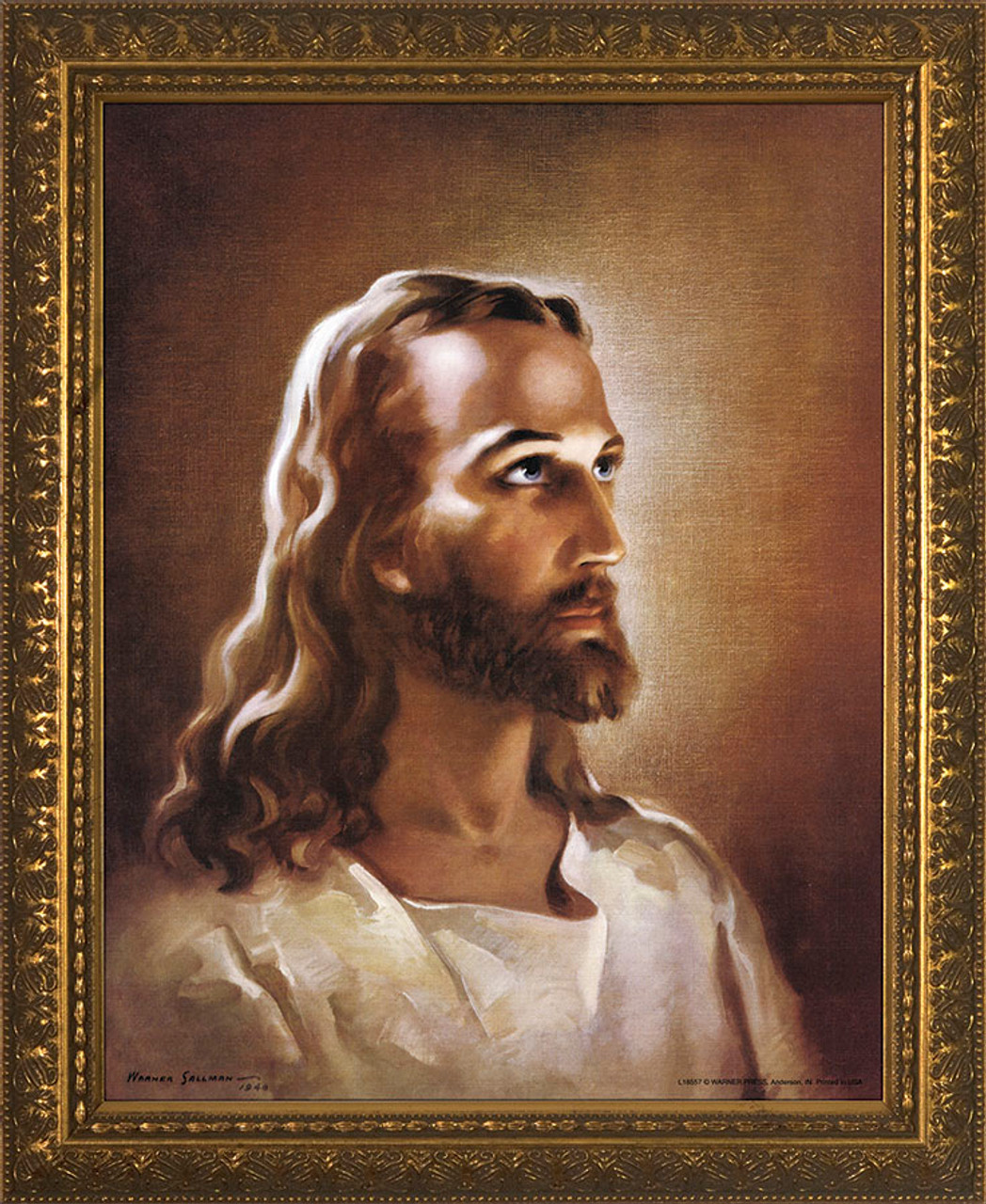
Now it is not my intent to pass judgment on whether my father-in-law was right or wrong in hanging this picture in his home. My intent is to get us thinking about how we use our minds when we read Scripture and to raise questions about the purpose of John’s visions of Christ in Revelation. I think A.W. Tozer was exactly right when he said, “What comes into our minds when we think about God is the most important thing about us” (The Knowledge of the Holy). There is a lot about God that we don’t understand, but the things he has revealed to us should occupy our minds in a way that leads us to worship. I believe this is the intent of John’s visions of Christ in Revelation.
What do you think? Do our artistic depictions of Christ unintentionally shrink him down to our size?
 Women Studying the Word