A couple years ago I started writing a series of Sunday posts about various Puritan authors. I thought I would bring that back. But instead of dedicating each post to a different author, I’d rather share quotes and reflections from the Puritan authors I’m currently reading.
I shared a post a little while ago that included a quote from Samuel Rutherford. Since last summer, I have been making it a habit to read from his Letters on Sunday mornings before church. Very quickly I realized how quotable he is and found myself agreeing with Charles Spurgeon who held that the Letters were as near to being inspired as anything written by a mere man.
Rutherford was a minister in 17th century Scotland during a very tumultuous time. His letters show a deep love for his flock, a passion for the beauty and worth of Christ and an understanding of suffering that few in the 21st century West can relate to. Here is something I read this morning concerning the love of Christ.
Alas! I can speak nothing of it, but wonder at three things in His love: – First, freedom. O that lumps of sin should get such love for nothing! Secondly, the sweetness of his love. I give over either to speak or write of it; but those who feel it, may better bear witness what it is. But it is so sweet, that, next to Christ Himself, nothing can match it. Nay, I think that a soul could live eternally blessed only on Christ’s love, and feed upon no other thing. Yea, when Christ in love giveth a blow, it doeth a soul good; and it is a kind of comfort and joy to it to get a cuff with the lovely, sweet, and soft hand of Jesus. And, thirdly, what power and strength are in His love! I am persuaded it can climb a steep hill, with hell upon its back; and swim through water and not drown; and sing in the fire, and find no pain; and triumph in losses, prisons, sorrows, exile, disgrace, and laugh and rejoice in death.
Are you as challenged as I am reading through that? If only I knew the love of Christ like this. But I’m afraid my spiritual appetite is too weak and willing to settle for a bite here and there instead of sitting down to the banquet feast that he offers. May we, like Rutherford, learn like the psalmist to feast on the abundance of God’s house, slaking our thirst from the river of his delights (Psalm 36:8).
My name is often misspelled. The day of my college graduation, I opened my diploma to see Meridith. Disappointing for sure, especially since it had never been misspelled on any other college documents, but when I sent it back for a replacement, it came back with the same mistake! It’s happened so often that I have actually come to expect it at places like Chick-Fil-A and Starbucks where they print your name on the sticky ticket they attach to your bag or coffee. One time I gave the barista a different name altogether, but now I find it funny.
The latest example
In Isaiah 44 God rebukes those who take a block of wood, carve an idol out of it and bow down to it. We would never do that, right? But there are many kinds of idols. Tim Keller defined an idol as “anything that absorbs more of our attention and imagination than God.”
Idolatry is one of the main reasons I have, for the most part, gotten off social media. I used to have a podcast. I enjoyed the process of writing and recording each episode. But when you create content online, there is another thing that comes with it – growing an audience. You make a podcast so that people will listen. But how can people listen if they don’t know about your podcast? You have to spread the word through social media. So I created an Instagram account for the podcast, requiring me to spend even more time creating content that would build an audience. But in the midst of all that I realized I was wading into some dangerous spiritual waters. The promoting of the podcast started getting entangled with the promoting of myself. I found myself constantly checking stats to see how many had listened, commented or liked. Pretty soon the creation of content got wrapped up in the temptations of idolatry.
Is it even possible to create content online and promote it without falling into the idolatry of self where your identity becomes a brand and you’re constantly curating your own reputation, making sure your name is noticed? How does a Christian blog, podcast, YouTube without losing their soul? The idolatry of self has always been a temptation for the essence of sin is to curve inward on yourself. But in our age of the expressive individual when the temptations are embedded in the technology we use every day, how freeing would it be to look away from yourself and focus on the name above all names?
My reputation has often been too important to me, something I have jealously but secretly guarded even without me realizing it. But lately I’ve been realizing how little my name and reputation matters. The truth is that my name will be forgotten in a couple generations but his name endures forever. That future and certain anonymity (at least among men) should not lead me to despair though, for, if I am in Christ, then I have taken on a new identity and bear his name. I am no longer just Meredith, or Meridith or any other way you want to misspell it! I am Meredith-in-Christ, Christ-in-Meredith, a new creation who is not losing her own personality and uniqueness but one who has been grafted into another, buried and raised with Christ.
Identity and names are a theme that runs through Revelation. In the letters to the seven churches, Jesus commends those who bear up under persecution for his name’s sake (2:3). They hold fast his name, not denying the faith (2:13). They may be weak but they keep his word and do not deny his name (3:8). As a reward, those who endure to the end will be given a white stone with a new name written on it (2:17). Jesus knows their names and they will never be blotted out of the book of life because he will confess their name before the Father (3:4-5). Even more precious, the name of God will be written on them: “The one who conquers, I will make him a pillar in the temple of my God. Never shall he go out of it, and I will write on him the name of my God, and the name of the city of my God, the new Jerusalem, which comes down from my God out of heaven, and my own new name.” (3:12)
How silly and shortsighted is it for me to worry about my own name and my own reputation when my whole life is bound up in Christ! Yes, my name will be forgotten by men, but not by the Lord. He knows my name, it is written in his book. And I will bear his name forever in the New Jerusalem.
“They will see his face, and his name will be on their foreheads.” Revelation 22:4
I’ve written about the Puritans before and today I’d like to introduce you to Samuel Rutherford. He was a Scottish Presbyterian minister and theologian who lived during the 17th century. For a time he was exiled from his own congregation because of conflict with Church authorities. During his time of exile he wrote an immense amount of personal letters which went on to be published. Charles Spurgeon said these letters were the closest thing to inspiration written by a mere man.
It’s tempting to think we’re smarter than those who lived 400 years ago. But while we can fly around the world, map the human genome, and access more information than we know what to do with, we tend to have a shallower understanding of God and the human soul.
I’ve been reading slowly through Rutherford’s letters and came across this quote below. Take your time reading this.
Providence hath a thousand keys, to open a thousand sundry doors for the deliverance of His own, when it is even come to a conclamatum est [Latin for ‘all is over’]. Let us be faithful, and care for our own part, which is to do and suffer for Him, and lay Christ’s part on Himself, and leave it there. Duties are ours, events are the Lord’s. When our faith goeth to meddle with events, and to hold a court (if I may so speak) upon God’s providence, and beginneth to say, ‘How wilt Thou do this and that?’ we lose ground. We have nothing to do there. It is our part to let the Almighty exercise His own office, and steer His own helm. There is nothing left to us, but to see how we may be approved of Him, and how we may roll the weight of our weak souls in well-doing upon Him who is God Omnipotent: and when that we thus essay miscarrieth, it will be neither our sin nor cross.
If I may try to summarize what he’s saying in modern English – let God be God. So many of our anxieties are caused by trying to take on what is not ours. But God’s providence means he has innumerable ways to accomplish his will, to work all things to our good. Our job is to just do the next right thing in front of us and commit the rest to him.
In general, there are two kinds of packages that arrive at our house: those containing fishing gear and those containing books. You can probably guess which are mine! I love my books, real physical books. Since entering seminary, my book buying habit has only gotten worse but I don’t see anything wrong with that. In fact, as my library has expanded I think I have discovered a new spiritual gift – the gift of book recommendation! All kidding aside, seminary requires a lot of reading. Not all of it is worthy of recommending, but some have risen to the top. Here are two books that I have found both spiritually enriching and helpful in increasing my understanding of certain theological topics. These are more on the academic side of things but if you’re interested in learning more, I encourage you to challenge yourself. Your hard work will be rewarded.
Living in Union with Christ: Paul’s Gospel and Christian Moral Identity by Grant Macaskill
This is one of the first books I read when I entered seminary. It was for a class on Paul’s epistles. It’s a short book that is based on a series of talks the author gave at Reformed Theological Seminary in Orlando. My professor assigned it because his contention is that the doctrine of union with Christ is at the center of Paul’s theology. What is union with Christ? Macaskill explores this question by unpacking verses like Galatians 2:20 – “I have been crucified with Christ. It is no longer I who live, but Christ who lives in me. And the life I now live in the flesh I live by faith in the Son of God, who loved me and gave himself for me.”
How do we see Christian moral identity? Macaskill’s contention is that evangelicals often describe and teach morality in a way that is functionally Christless. We inadvertently present sanctification as being about becoming a better version of ourselves instead of being formed into the image of Christ through the indwelling power of the Spirit of Christ in us. Here is one of many quotes that got me thinking much more deeply about how we talk and teach about the Christian life:
“The key point explored in some detail through the body of this book can here be summarized in terms of the prepositions that govern it. Jesus Christ is not represented simply as the one throughwhom we have forgiveness, or even as the one by whom the moral life is exemplified, but as the one in whom the life of discipleship takes place. Christ himself is present in the life of the disciple as the principal moral agent. We are not simply saved by him, nor do we merely follow after him – though both of these continue to be true – but we participate in him. This is why Paul so frequently specifies that the realities of the Christian life are ‘in Christ.'”
How do you think about obedience and growth in the Christian life? Is it just about becoming a better person with a little Jesus on the side? Is it more like Christian self-help? I’ve read this book twice now and the truths it contains continue to reverberate in my own soul and influence my teaching. Take your time and read this one slowly. One caveat though – you can skip chapter 1 if you’re not interested in reading a short history of the scholarship behind Pauline theology.
Created in God’s Image by Anthony Hoekema
This book was assigned in one of my systematic theology classes. It covered the topic of the doctrine of man. What makes up a human being? What does it mean to be created in the image of God? I was especially interested in the author’s chapter on whether man is made up of a body and soul, or does Scripture portray our makeup as body, soul, and spirit. If you’ve been around American evangelicalism for a while you may have come across this diagram:
But what if this diagram is wrong? What if it doesn’t line up with how the Bible talks about the self? Hoekema argues effectively against the above view of man as made up of three parts, often referred to as trichotomy. But he also questions the most common view which is called dichotomy – man being made up of a body and soul. He says while the Bible does use different words in speaking of the various so-called ‘parts’ of man – mind, spirit, soul, heart, flesh, etc. – we must remember that this language was never meant to be interpreted through a scientific or psychological lens. For example, when Jesus tells the lawyer in Matthew 22 that the greatest commandment is to love God with all your heart and with all your soul and with all your mind, he was not giving a lesson on the psychological makeup of human beings. His point was that we are called to love God with all that we are.
Hoekema argues for what he calls psychosomatic unity, a phrase that acknowledges the variety of language the Bible uses in describing the human condition while also stressing the basic unity of man. Here is a quote from the book:
We may summarize our discussion of the biblical words used to describe the various aspects of man as follows: man must be understood as a unitary being. He has a physical side and mental or spiritual side, but we must not separate these two. The human person must be understood as an embodied soul or a ‘besouled’ body. He or she must be seen in his or her totality, not as a composite of different ‘parts’. This is the clear teaching of both Old and New Testament.
But why does this matter? You might not think it’s a big deal, but Hoekema points out several areas where an emphasis on the whole person, not just individual parts, has a great impact: the church, the family, school, medicine, and counseling. We must see men and women as whole people if we are to effectively minister to them, teach them, and heal them. It’s also important to recognize when we are emphasizing one ‘part’ of man at the expense of the whole. One aspect that Hoekema did not address, and could not have anticipated when he was writing in 1986, was the advent of technology like the metaverse and AI. These technologies are powerful tools but they also seek to redefine what it means to be human. Can you be a member of a church, even be baptized, without ever physically attending a real building with real live people? If that seems ridiculous, then click here to learn about something called VR church.
This is just a taste of two books that have made a big impact on me since entering seminary. Most of us will not go to seminary, but we can all challenge ourselves to read more deeply.
In December of 2023 I went on a mission trip to Guatemala and was gone for about ten days. When I came back I learned that my husband had binge watched every season of The Chosen while I was gone and he was eager to have me watch the series with him. For the next couple months we made our way through each episode and had a lot of fruitful discussion. It’s undeniable that a lot of care has gone into the production of this series. But it’s also obvious, at least for those with a modicum of Bible literacy, that they’ve taken some liberties in how they’ve presented the gospel stories.
When the series first premiered and became popular I was very hesitant to watch. I read glowing reviews from people who said the series made the Bible come alive for them and really encouraged them in their faith. But I had questions. Shouldn’t the Scripture be sufficient in revealing to us who God is? God could have decided to wait and send his Son into the world at a time after video technology had been invented. But he didn’t. Some were educated enough to read and write but many were not. Isn’t there a reason why Jesus is called “The Word”? God’s special revelation came to us in a person and in a book, not a TV show. And what would happen if I watched the show and then my own Bible reading was unduly influenced by pictures of Jonathan Roumie in my head? My husband would counter and say that we all use our imaginations when we read the gospels. But what about the second commandment in Exodus 20 which forbids us from making an image of anything and worshiping it as God?
There are many questions to consider (and if you’d like to read some very good reflections on it and the role of the Christian conscience I recommend going here), but for this post I’d like to think about the pictures Scripture gives us of Christ, specifically in the book of Revelation.
At the incarnation, the second person of the Trinity assumed a human nature, but we are not told very much about his appearance. One description that comes close is in Isaiah 53:2-3: “For he grew up before him like a young plant, and like a root out of dry ground; he had no form or majesty that we should look at him, and no beauty that we should desire him. He was despised and rejected by men, a man of sorrows and acquainted with grief; and as one from whom men hide their faces he was despised, and we esteemed him not.” This is not an particularly attractive picture but we must also balance it with what Luke reports in Luke 2:52: “And Jesus increased in wisdom and in stature and in favor with God and man.” While we cannot know for sure, Jesus the man was probably plain looking but enjoyed the favor of both his Father and the people around him. For a while he had a good reputation.
But we must always remember that the second person of the Trinity is both God and man and that forever. There is a lot of mystery here for sure, but we do know from the Scriptures that Christ’s assumption of a human nature continues forever. His physical body was raised from the grave and he is at the right hand of the Father interceding for us as one person with two natures. If that seems confusing to you, join the club, because it’s one of the most difficult doctrines in the Christian faith. If you want help going deeper though, I suggest you go here for a concise primer on what theologians call the hypostatic union.
With that said, let’s move on to Revelation. My point here is to get you thinking about what you think about when you read the descriptions of Christ in this last book of the Bible. Because it’s easy for us to slide into an unbalanced view of Christ, especially if we’ve been unduly influenced by productions like The Chosen, The Passion of the Christ or even if we’re in the stage of life where we’re spending a lot of time reading children’s Bibles to our kids.
Let’s focus on three different pictures of Christ – the glorious Son of Man in Revelation 1, the Lamb standing as if slain in Revelation 5 and the rider on the white horse in Revelation 19. What is your mind doing as you read these descriptions?
Revelation 1:12-16 says:
Then I turned to see the voice that was speaking to me, and on turning I saw seven golden lampstands, and in the midst of the lampstands one like a son of man, clothed with a long robe and with a golden sash around his chest. The hairs of his head were white, like white wool, like snow. His eyes were like a flame of fire, his feet were like burnished bronze, refined in a furnace, and his voice was like the roar of many water. In his right hand he held seven stars, from his mouth came a sharp two-edged sword, and his face was like the sun shining in full strength.
Next, Revelation 5:5-7 says,
And one of the elders said to me, “Weep no more; behold, the Lion of the tribe of Judah, the Root of David, has conquered, so that he can open the scroll and its seven seals.” And between the throne and the four living creatures and among the elders I saw a Lamb standing, as though it had been slain, with seven horns and with seven eyes, which are the seven spirits of God sent out into all the earth. And he went and took the scroll from the right hand of him who was seated on the throne.
Finally, read Revelation 19:11-16:
Then I saw heaven opened, and behold, a white horse! The one sitting on it is called Faithful and True, and in righteousness he judges and makes war. His eyes are like a flame of fire, and on his head are many diadems, and he has a name written that no one knows but himself. He is clothed in a robe dipped in blood, and the by which he is called is The Word of God. And the armies of heaven, arrayed in fine linen, white and pure, were following him on white horses. From his mouth comes a sharp sword with which to strike down the nations, and he will rule them with a rod of iron. He will tread the winepress of the fury of the wrath of God the Almighty. On his robe and on his thigh he has a name written, King of kings and Lord of lords.
One of the many reasons God forbade the Israelites from making images is because they necessarily diminish God and bring him down to our size. Images of God lie to us, telling us that he is someone we can control. When we try to picture something or someone we’re attempting to understand and that’s not always a bad thing but on the flipside, that picture tempts us to think we have grasped that thing or person, that we have some level of control over it.
While there is true comfort in reading the gospels and knowing that the second person of the Trinity, the very Son of God, walked among us and ate and talked with us, healed us and touched us, there is more to him. The disciples saw that on the Mount of Transfiguration, they realized it when he appeared to them out of nowhere following his resurrection and when he ascended into heaven before Pentecost. And here in Revelation, John sees visions of Christ that he can hardly describe in words so he uses pictures that his readers could relate to. But these pictures were never meant to be hung on the wall, but to bring us to our knees in worship, realizing that Christ is far more glorious than we could have ever imagined. Each of these visions of Christ is meant to remind his readers of the whole story of Scripture and help them connect the dots from Daniel’s Son of Man, and the lambs that were slain on Passover, and the images of God as a victorious warrior from the prophets.
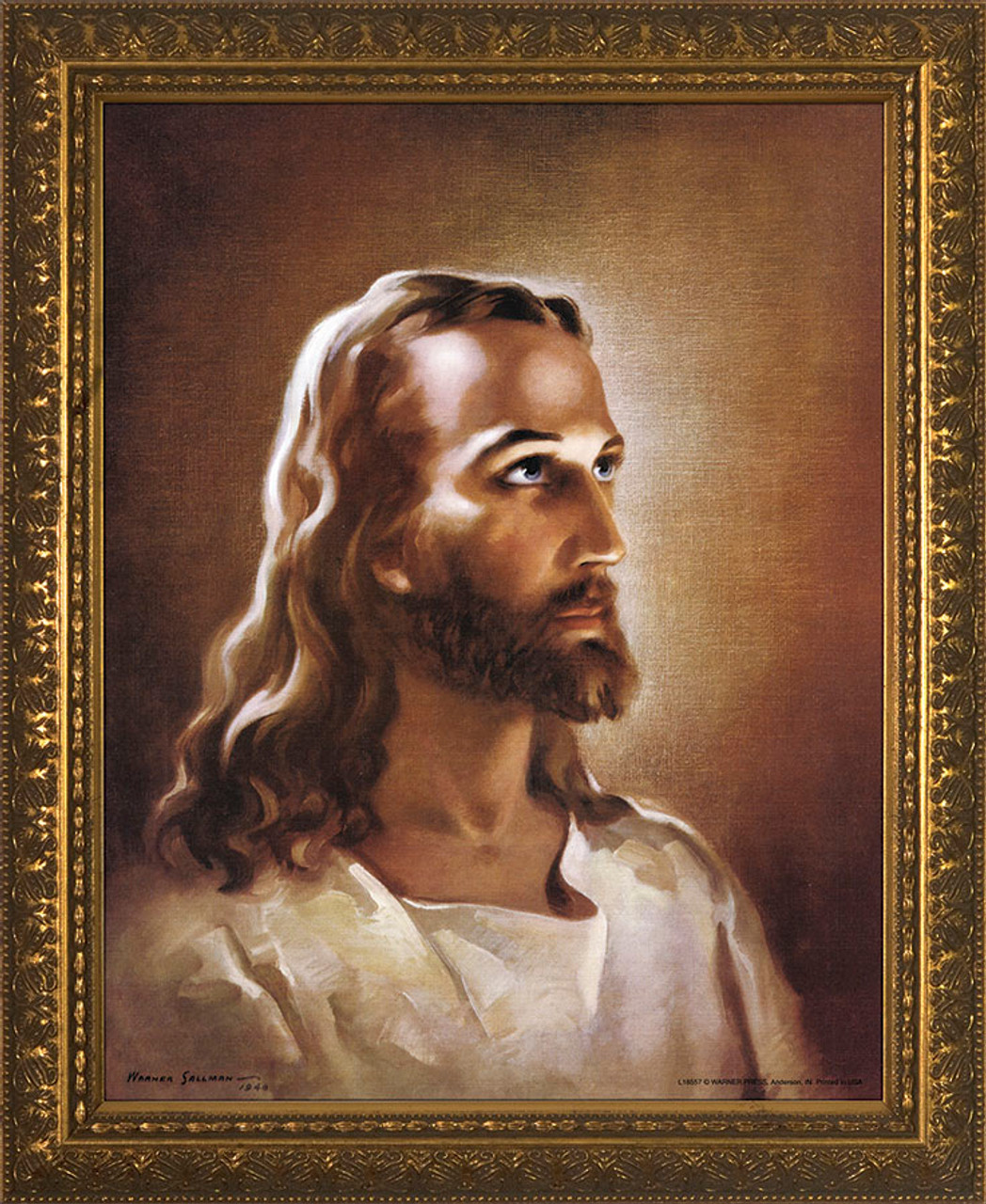
My father-in-law had a framed picture of Christ hanging in his home for years. He always hung it near the door and it was very precious to him. It looked a lot like this:
Now it is not my intent to pass judgment on whether my father-in-law was right or wrong in hanging this picture in his home. My intent is to get us thinking about how we use our minds when we read Scripture and to raise questions about the purpose of John’s visions of Christ in Revelation. I think A.W. Tozer was exactly right when he said, “What comes into our minds when we think about God is the most important thing about us” (The Knowledge of the Holy). There is a lot about God that we don’t understand, but the things he has revealed to us should occupy our minds in a way that leads us to worship. I believe this is the intent of John’s visions of Christ in Revelation.
What do you think? Do our artistic depictions of Christ unintentionally shrink him down to our size?
I have a love hate relationship with the whole productivity industrial complex. Why do I call it that? Because it’s a thing. You see it all over social media and the publishing world. How to maximize time. How to get things done most efficiently. This appeals to a lot of us, especially people like me who are prone to perfectionism. Mondays are the perfect day for me to plan, strategize and make lists. I love lists. On Mondays I usually make a list called a ‘Brain Dump’. This is where I just list everything I can think of that I want to get done in the week. It helps to download all of it onto paper.
But how does God see productivity? I have been asking myself these questions lately. Going back to school has added a lot to my list and the old perfectionism rears its head when I look at the syllabi for my classes filled with hundreds of pages of reading and parameters for research papers. How to get it all done? How can I schedule my day in a way to not get behind? What about all the other responsibilities in my life? Someone has to cook dinner and clean toilets after all.
The first class I took in seminary was called “Redemption Unfolded”. The class covered the overarching story of Scripture and while the subject matter made an impact on me, the teacher also left an indelible mark. He wasn’t a professor at the seminary, but a local pastor, and this was his first class. After introductions he had us read out loud the following Scripture and meditate on it silently:
Whatever you do, work heartily, as for the Lord and not for men.
Colossians 3:23
Work heartily? Yes! This was why I was in seminary. I was eager to work heartily, to read widely and deeply from authors I’d not been exposed to, to learn the original languages in order to peel back and expose the beauty and depth of God’s word, and to enjoy all kinds of theological conversations with my professors and classmates. But wait. There’s more to this command.
Work heartily as for the Lord and not for men. This is what cut me to the quick that day. The Holy Spirit put his finger so to speak on this area of my heart, this place that still needed to undergo his refining work. And this area is still under construction, two years later, as I make my way through another semester. This semester has been very difficult because of the added stress of caring for my aging parents and grieving the loss of my father-in-law. As I saw the amount of work in front of me, I began to panic, and I grasped for ways to perfectly organize my time and my assignments. Being organized is good, but panicking is not and the Lord showed me exactly where that panic was rooted – in idolatry. When I work heartily for man and not the Lord, I am motivated by grades and reputation. I get consumed with anxiety about what others will think if I don’t maintain a certain standard. Not only that, but what will I think about myself?
I don’t know all the answers when it comes to a faithful approach to productivity, but I have begun to recognize the traps that I fall into. One of those is the idolatry of achievement and reputation as I described above. The other is believing the lie that I am the master of time. If I could only organize each hour perfectly according to the priorities that I have established, then I could lay my head down on the pillow at night fully satisfied. But this mindset encourages us to live contrary to our natures as limited creatures. We are not master manipulators of the minutes of our lives. We are not God! And it also goes against how God sees growth and productivity in our lives. First of all, he is in charge. Yes, we are called to work out our salvation but that is rooted in and empowered by the work that God continually does in us for his good pleasure. (Phil. 2:12-13).
We are the clay and not the potter.
We are the branches and not the vine.
We are the sheep and not the shepherd.
Second, growth is slow. While we’re focused on speed and efficiency, God is calling us to learn from his creation about faithfulness and perseverance over a long period of time. Clay takes time to be molded by the careful and loving hands of the potter. Branches take time to develop and grow until the buds form and fruit appears. Sheep take time to learn their master’s voice and follow his commands. Think about how ridiculous it would be for the potter, the gardener, or the shepherd to stand over his work, hands on hips, impatiently crying out, “Will you just hurry up!” But we look at our lives, our children, and our work like this, as if everything could be microwaveable and should progress onward and upward in an unbroken line.
There’s a fig tree planted in my backyard. We planted it almost five years ago and it still hasn’t borne fruit. Last year it came close. As I observe the tree out of my kitchen window this spring, again putting out buds and then leaves, I think about the patience and kindness of God and I ask for wisdom. Wisdom to realize that I am not a machine but a limited creature who is dependent on the Lord for life, health and breath. Wisdom to see when my work becomes more about me and less about him and those I’m called to serve. With my mind renewed I can then reframe what productivity means. I’m coming to realize that it has much more to do with faith-filled patient work that bears fruit over the long haul.
This is a question I receive regularly when people learn I am going to seminary. For those who don’t know me, I am a middle aged woman with adult children who has an undergraduate degree in music but has also homeschooled her children and cleaned other people’s houses for a living. So why am I going to seminary? And why now?
In the early years of my Christian life, back in college, God gave me a desire to learn. I joined a women’s small group and did fill in the blank Bible studies by Cynthia Heald. I dove in head first, eagerly absorbing all the truth I could. The leader of that small group was going to seminary nearby at Trinity Evangelical Divinity School. She brought me to the bookstore one day and I remember buying this big blue book.
Not the typical book for a new Christian, I know, but it intrigued me and in the following decades I made my way slowly through most of it as I got married and had kids and had time for more theological reading. I was drawn to deep theology because I saw the difference it made in my own soul.
About ten years ago I started teaching Bible study in my local church, desiring to share what I had learned. But it became more than that. After reading Jen Wilkin’s book Women of the Word, I was convicted that teaching wasn’t about showing off how much I knew, but loving the women God had given me to teach. Did I love them? That has changed the way I teach for the better. Instead of filling my lessons with cool Bible facts, I try to focus on the women in my classes and what they need. That requires a lot of prayer and a lot of editing.
This gets me to why I decided to go to seminary. During those days of cleaning people’s houses I would binge on podcasts, especially Nancy Guthrie’s How To Teach the Bible. There were many times while I was vacuuming or cleaning a kitchen when I would have to stop and pray while listening to her podcast because there was this deep and overwhelming urge in my own spirit to teach more and to serve women better by giving them the Word.
Several years ago, I happened upon a Facebook group dedicated to encouraging women in the Bible. I can’t remember the name of it or who was sharing this post, but I do remember my reaction to the post. The best word to describe it is visceral – it was a deep angst in my spirit. Let me explain the post for you and then hopefully you can understand my reaction. The post centered around an obscure verse in Nahum 3. Verse 13 says, “Behold, your troops are women in your midst…” The woman commenting on this verse ripped it out of its context declaring that the Lord had given her this verse that day and wanted her to communicate to her readers that they should have courage as women warriors for God.
I hadn’t studied Nahum, but I had read enough of the Old Testament to know that this verse was never meant to be understood as a way to say, “You Go Girl!” It’s actually an insult! Nahum 3 is a declaration of woes from God upon Nineveh and to say that your army is a bunch of women is not meant to be a compliment and it’s certainly not meant to be an empowerment message to modern women. And guess what, the woman who wrote the post knew that too! But she pushed back against those who would question her interpretive methods by marginalizing those who desire to handle the Bible responsibly according to things like context, and elevated her own experience and what she thought the Lord was telling her.
As I said, my reaction to this post was visceral, it was like a boiling over in my spirit. No! This is not what women need! They don’t need to learn irresponsible ways of handling the Scripture. It’s not about plucking verses out of their context and then applying them to yourself according to how you feel that day. Responsible Bible study methods are not boring and dry. They actually get you deeper into the text and deeper into the heart of God. And they also honor the God who gave us his Word. He wants us to know him but he also wants us to handle his Word rightly.
Sadness accompanied my visceral reaction as I read the comments on this post. Most of the comments were filled with thankfulness for the message of empowerment. It was obvious that many were focused more on the immediacy of application instead of the priority of rightly handling God’s Word.
Soon after reading this Facebook post I began researching how to go to seminary. I wasn’t sure at the time whether I was experiencing a true calling or not, but I knew that God was doing something in my spirit, stirring up a passion that had been growing in me for a long time. That passion centers around helping women understand the importance and the benefit of rightly handling God’s Word. I want them to be anchored in the whole truth of Scripture, rooted deeply in the complete picture of God. This is how I want to love women well and this is why I’m going to seminary.
In The Chronicles of Narnia, C. S. Lewis uses the metaphor of deep magic to describe the atonement Aslan accomplishes on Edmund’s behalf at the stone table.
“It means,” said Aslan, “that though the Witch knew the Deep Magic, there is a magic deeper still which she did not know. Her knowledge goes back only to the dawn of time. But if she could have looked a little further back, into the stillness and the darkness before Time dawned, she would have read there a different incantation. She would have known that when a willing victim who had committed no treachery was killed in a traitor’s stead, the Table would crack and Death itself would start working backward.”
With poignant power, Lewis creatively recasts the death of Christ in a way that children (and adults!) could never forget. What happened at the Cross was a deeper magic, but how many of us have really plumbed the depths of that holy transaction?
Puritan theologians were active mostly in the late 16th and 17th centuries. I affectionately call them “the good old dead guys.” One of their common strategies was to take one verse and wring out of it every drop of gospel sweetness. These were men who plumbed the depths, who took the time to think deeply about every theological implication. John Owen, in his exposition of Psalm 130, spends 227 pages exploring the depths of verse 4. Yes, you read that right. Over two hundred pages on one verse. I encourage you to read the whole psalm for context because verse 4 begins with an important transition word: “But with you there is forgiveness that you may be feared.” The psalmist is crying for mercy and knows that if God were to mark our every iniquity, every single transgression in thought, word, and deed, we would rightly perish. What Owen does in his lengthy exposition of verse 4 is explore the inner logic of the gospel, what Lewis called the deeper magic. How can a holy God who demands perfect righteousness, forgive sinners?
Have you ever thought to ask that question? Have you presumed God’s forgiveness without ever realizing what it cost? These are the questions Owen asks as he challenges his readers to go deeper. Here is one quote that stunned me:
To see into the mystery of the love of the Father, working in the blood of the Mediator; to consider by faith the great transaction of divine wisdom, justice, and mercy therein,—how few attain unto it! To come unto God by Christ for forgiveness, and therein to behold the law issuing all its threats and curses in his blood, and losing its sting, putting an end to its obligation unto punishment, in the cross; to see all sins gathered up in the hands of God’s justice, and made to meet on the Mediator, and eternal love springing forth triumphantly from his blood, flourishing into pardon, grace, mercy, forgiveness,—this the heart of a sinner can be enlarged unto only by the Spirit of God.
Go back and read that again, and maybe again, not only because of the clunky 17th century English, but because of the profound truth that’s contained there. Take time to savor the sweetness like a Werther’s Original melting in your mouth. We may think that our generation especially doesn’t have time for this, or it’s just too hard, but look at what Owen says about his own! Few in his time attained to this understanding of what the blood of Christ accomplished and so few came to a deep understanding of the mystery of the love of the Father. A shallow understanding of forgiveness will lead to a shallow understanding of God’s love.
Let’s pray that the Spirit of God, who alone can stir within us to desire this, will work in us to enlighten the eyes of our hearts to comprehend this deeper magic.
One of the most helpful things I’ve learned from the Simeon Trust workshops is how to find the melodic line in a book of the Bible. As a Bible nerd, I love digging into the details of a passage, pursuing cross references and doing word studies, but hadn’t considered the value of looking at a book as a whole unit. What is the main theme of a book? How does that guide us as we dig deeper?
As a musician, this concept also appealed to me because it was taught using the illustration of a music staff, like this:
If you don’t read music, most of these notes are a different pitch and different lengths. Each music note is supposed to represent a key component of the book of the Bible. It could be a repeated word or phrase. It could be the way the book is structured. Your job is to find these notes and examine how they relate to one another. Which ones are more important? Which ones are instrumental (pardon the pun) in developing the theme? But how do you do this? Here are some strategies that I have used in studying Revelation.
Read and Reread
Repetitive reading is a highly underused Bible study skill. One of the reasons for this is because we have all been conditioned by our culture and technology to read in a way that is fast and reductive. We want to get to the point and right now! This creates readers who skim on top of the surface of the text instead of deep divers who go below to explore the depths. Slowing down and taking the time to read a passage over and over again helps you notice things.
Listen
I used to think that listening to a book didn’t count. I still prefer reading silently over listening to someone read aloud, if only to be able to control my pace, but listening is how most Christians took in the book of Revelation until only a few hundred years ago. People just didn’t have access or were not literate. How blessed are we to have so many options! Let’s take advantage of them. One of the main benefits I have found in listening to Revelation is catching the tone of the book. Every book has a certain tone, mood, or if we’re talking music, a key signature. The book may start in a minor key (sad, dark, or ominous) but then modulate to major (happy and peaceful resolution). Lament psalms often do this. In my many trips over to South Carolina to help my parents, I have taken advantage of that 3-4 hour drive (depending on Atlanta traffic!) to listen to Revelation straight through multiple times.
Epic.
That is the first word that came to mind when I thought about the tone of this book. It is a grand and monumental story that sweeps the reader up into visions of worship and judgment, an enemy dragon and a redeeming Lamb that was slain but is standing! There are dire warnings but also wonderful assurances of reward for those who conquer. If I had to choose a composer to write the soundtrack of Revelation it wouldn’t be Mozart. It would be Mahler. This book is meant to move us.
Repeated Words
As I read through the book I began noticing all the repeated words and phrases. This is a prophetic vision given to John so the words saw, looked, heard, and show are repeated over and over, more than 70 times! This helps us understand the kind of book this is. It is not a historical narrative that John retells in chronological order. He is showing us in highly symbolic language different pictures of the same period of time between Christ’s first and second comings. And what image is at the controlling center? This gets to another repeated word – throne. This word is repeated over 40 times in the book, especially in chapters 4 and 5. After the letters to the seven churches and before the cycles of judgment begin with the opening of the seven seals, John is whisked up into the heavenly throne room of God. Why? God wants him to know and his readers to know that whatever happens in this book, the Lord is in control. He is worthy and he reigns over it all.
Speaking of sevens, that word occurs over 50 times in the book. Numbers play a big role in Revelation and none more importantly than the number seven. Seven is the number of wholeness and completion. It is fitting that the book that brings every theme and every promise of the story of Scripture to fulfillment contains so many sevens. This is a book about ultimate consummation.
Top and Tail
Top and tail is a strategy that looks at the beginning and end of a book to see any parallelisms. If an author begins and ends by repeating similar words or phrases or repeating a purpose statement, that gives us a clue as to what the author is wanting his reader to focus on.
If we compare the beginning and end of Revelation we see a few things highlighted:
Christ is the central focus as the Alpha and Omega, the beginning and the end.
The message is given to show what must soon take place – Jesus is coming!
There is a blessing for those who keep the message of this book.
The purpose statement of the book is also repeated at the beginning and end. In Revelation 1:1-3 and 22:6 we read that the Lord has sent his angel to make known to his servants what must soon take place. This book is an unveiling, a revealing, not a puzzle to unlock with a secret decoder ring.
What then?
There are several other strategies I used to help find the melodic line, but for now let’s take what I’ve mentioned above and try to put it together. One thing to remember is that this melodic line is tentative and open to refinement. As you go along in deeper study, you will see things that you’ve missed and you’ll want to adjust your melodic line. But doing this before getting into that deeper study, will give you a strong sense of what the author is trying to communicate. It will also keep you on track. If you come up with an interpretation that clashes with the main purpose of the book, you may want to rethink that interpretation.
If you explore the Simeon Trust website you’ll find a wealth of resources there including audio recordings of past workshops. I pulled one up on Revelation and heard the speaker guide some pastors in coming up with a tentative melodic line. Here are two ideas they came up with:
“Blessed is the one who keeps his words for Jesus is coming soon.”
“Jesus is coming soon and will reward those who endure.”
Notice how they both include the main event the book is pointing toward – Jesus’ second coming. They also include the ideas of blessing and endurance. What’s important is that you include words from the text in your melodic line so that it carries the identity of the book. If you make your melodic line too general it could apply to several different books. Your melodic line for Revelation should carry with it the distinct flavor of this book.
What did I come up with? It’s still tentative and probably needs to be edited, but my first stab at a melodic line for Revelation is this:
Blessed are those who patiently endure in the testimony of Jesus, for the Lamb has conquered and is coming soon to judge his enemies and usher his bride into the New Jerusalem.
In doing this exercise, I am a lot less confused about how to approach this book. I am able to see the overarching purpose and themes that God wants his people to see. And that fills me with excitement as I get into deeper study.
Has this helped you understand Revelation better? How can you use this concept of a melodic line in your own Bible study?
The past two months have been very stressful for my family. The details are not important to this post, but because of these events I have found myself attending my parents’ church more often. It is a small Anglican Catholic church made of stone and the inside is filled with beautiful dark wood and floors that creak. Here is a picture of what it looked like over the Christmas holidays.
I grew up in the Episcopal church but didn’t come to faith in Christ until I was in college. After college I moved to Atlanta and since then I have been a member of two very large Southern Baptist churches. I met and married my husband at the first and then we raised our family at the second where we’ve been members for the past 28 years. One thing we love is being involved in the music ministry, he in the choir and me in the orchestra. Over the years the style of worship has changed and evolved resulting in a more traditional service in the sanctuary with pews and hymn books and a more modern service that takes place in the activity center. That venue has become the most popular over the last five years. There’s a band and lights and all the things that are common in American evangelical megachurches right now.
The small Anglican church has two services on Sunday. The early service is called a prayer service and there is no singing and no sermon. This is the only service my parents attend. The priest leads us through a liturgy that includes the corporate recitation of prayers, creeds and Scripture and culminates in coming to the altar, kneeling, and receive communion. The readings of Scripture change each week but it is generally the same each and every Sunday.
When I first started going I had mixed feelings about it. I love to sing. No wait, I need to sing! It is spiritual food for my soul. Not singing in church feels wrong. I’m also a Bible nerd and love good preaching. So each time I would go to this prayer service in the small Anglican church I would always leave feeling like I was missing something. I also wasn’t sure how I felt about all the sameness, the rote nature of it every week. It struck me as cold and insincere. But I also could appreciate it in a way that I never could when I was a child and an unbeliever. Now I understood everything I was saying and realized how much Scripture was packed into the liturgy! We were reciting psalms and creeds and prayers that were chock full of wonderful truth. In 28 years at my large SBC church I can only remember reciting a creed in the worship service one or two times.
But if I’m being honest, I still looked down on it. My church was better. My way of doing church was superior. There was more life, more warmth, more sincerity.
Over the past two months I have started to change my mind a little bit. Some of that has to do with a new priest at the church who I’ve gotten to know. He is young and vibrant and just as much a Bible nerd as I am. I’ve noticed that he is very intentional about how he recites the liturgy. When he quotes the words of Christ to the disciples at the Last Supper, he slows way down.
This………….is…………my………….body.
And likewise,
This………….is………….my………….blood.
I haven’t asked him why he does this yet, but it’s spurred me to ask this question: Have I ever meditated deeply on these words? His intentionality is encouraging me to do so. Speaking of communion, the small Anglican church offers it every Sunday. Can this encourage someone to take it for granted? Yes, if you’re not careful. But what about the large SBC church? There’s a danger there in celebrating the Lord’s Supper too infrequently. Someday I’ll finish my draft of a post about the formative value of the sacraments, but for right now, I am appreciating the thoughtful intention of this new priest who has encouraged me to slow down and contemplate more deeply.
But what about the sameness of the liturgy? I have a vague memory as a child being involved in our Episcopal church as a kind of junior acolyte. Every Sunday it was the same recitations, the same prayers. I almost had it memorized. But I didn’t understand it! As I’ve been attending the small Anglican church more often, I’ve started thinking about the significance of the sameness. This world is full of change which only seems to be getting faster and crazier. What if the sameness of this liturgy is a kind of polemic in our cultural chaos, calmy and consistently preaching the faithfulness of God and his word? One of the ministry philosophies at our church is an unchanging message but ever changing methodologies. I can see the wisdom of that, up to a point. At its best you make sure to be creative in how you reach people. But I can see how this philosophy can easily become unbalanced where the church ends up sticking its finger in the wind to see what will appeal best to a consumeristic community.
Not many people attend this early prayer service at the small Anglican church. And following the liturgy is not always easy. Some don’t know when to stand or what to recite. I’m still getting lost trying to figure out what page we’re on in the prayer book and when we’re supposed to stand and sit. But despite the awkwardness and imperfection, despite the seemingly timid and lackluster voices around me, there’s a simple yet powerful beauty to the corporate experience of reciting the ancient creeds and standing silently as the deacon comes to put out the candles at the end of the service. There may be something missing in this service that’s present in my Southern Baptist megachurch, but my church isn’t filled with as much soberness and dignity. It has been calming to me to enter into this small space and enjoy the silence of just being in God’s presence.
One of those Sundays when all was seemingly unpredictable and crazy in our family, my dad and I drove back to the house after the prayer service. I told him that his church may not be the same as mine, but I was beginning to appreciate many things about the liturgy that I hadn’t understood before. The sameness that seemed boring and lifeless to me now stood as a comforting reminder that some things remain the same: God, his Word, and the free invitation to partake of the sacrament of communion. The predictability of the liturgy was serving as an anchor during the storm we were experiencing.