Being the Best Christian

There once was a girl who wanted to be the best. She was pretty good at school and half decent at swimming but one day she took up the clarinet and after a few years realized she was more talented than most. So she practiced. She took private lessons. She received recognition and was rewarded with solos and awards. Being first, being the best, felt good.

Moving to a new state to start high school was tough, but this girl soon found her niche in the band. Her parents found her a new private teacher and drove many miles each week to take her to all her lessons and rehearsals. Then came auditions for honor bands and big city youth orchestras. She continued to succeed in capturing one honor after another, more solos and first chair placements. When she failed to beat out the competition, she felt bad and tried not to get discouraged, but it was impossible for her to keep from comparing herself with others. That mentality had become a default switch. She wanted to be the best.

The clarinet was the center of this young girl’s life and her talent eventually brought her to one of the best music schools in the country. Filled with ambition, she set out, at least subconsciously, to find out that first year in college who all the clarinet players were and where she ranked. She wanted to be the best after all. That was the only way to get the awards and the recognition and to one day get the coveted symphony job she so desired. As she labored daily in the practice room, it felt really good to see her name rise in the ranks after each audition. By the end of that first year she found herself sitting in the top orchestra next to the number one player. She saw nothing wrong with her ambition.

Early in her second year, some things went seriously awry in this girl’s personal life and she found herself lonely and lost. But in the midst of this lostness, the Lord was seeking her. Friends invited her to church and she began to read the Bible. She met Jesus Christ and realized she was not the best after all. She came face to face with who she really was at heart – a sinner in need of redemption. Within a short time after placing her faith in Jesus Christ, she found a kind of fulfillment and joy in her relationship with God that the clarinet couldn’t give her. There were brand new desires planted within her reborn self. Music started to become something different and her relationship with Jesus Christ slowly began to reshape her goals and ambitions. For sure, being the best clarinet player was still a goal, but others around her started to become people to love instead of people to impress or obstacles to climb over in getting to the top.

That girl with the clarinet who wanted to be the best was me of course. I turned 53 this year and have now been following Christ for almost 34 years. The girl who came to faith at 19 seems like a world away and I am filled with thanksgiving for how God has worked in me, as Paul says in Philippians, “to will and to work for his good pleasure.” But that desire to ‘be the best’ followed me into my Christian life and still lurks in the shadows, subtly trying to exert its influence. Being born again doesn’t completely rid us of the ingrained habitual sin that’s shaped us. Some habits of the flesh, some ways of being and thinking and operating in this broken world, cling so closely and are so multi-layered that it takes decades to see progress. And certainly the renewal of the mind that is part of the sanctification process won’t end until we are free of this flesh and stand glorified in the presence of God.

But how has this particular sin pattern followed me into my Christian life and what has that looked like these past 34 years? What God has shown me is that the genuine zeal he gave me in pursuing holiness can be intertwined with legalism and pride, turning my motivation from pleasing the Lord to ‘being the best’. Not the best clarinet player, but the best Christian.

As a new Christian, it looked like trying to have my ‘quiet time’ every day, because all the books on spiritual growth advised that and all the ‘best’ Christians did that. When I succeeded I felt good. When I missed a day or two or maybe a week, I lamented about how bad I felt in my journal. Over the years the Lord has been faithful to teach me that this ‘quiet time’ is really about cultivating communion with Father, Son, and Holy Spirit and that can be done in the morning but also throughout the day as I learn to delight myself in him.

As a young mom, this ‘be the best’ mentality made me think that being at home and having my babies follow a strict schedule was the only way to be a good mom. That’s what Elisabeth Elliot and Growing Kids God’s Way recommended after all. I remember meeting another young mom who carried her baby in a sling and silently judging her, thinking she was really spoiling her baby. As my children grew, the Lord has been faithful to convict me and chip away at my pride, teaching me that parenting is not a competition and my children are not trophies.

As I’ve grown in my faith, I have faced the temptation to look at others and what they are doing, whether serving the needy and vulnerable, or giving to missionaries, and think that I have to do all those things and do them better. I have sometimes approached the Christian life like a Girl Scout, ambitious to fill my sash with all those merit badges. But the Lord has taught me about the goodness of my limitations and the body of Christ who works together, each member needing the other to serve the Lord and love others all for his glory, not mine.

You would think that after almost 34 years of walking with the Lord, this ‘be the best’ mentality would hardly be a problem anymore, a thing of the past that I’ve outgrown. While the Lord has given me more wisdom and discernment to see it, it still entangles me from time to time. When I entered seminary in 2023, it reared its ugly head and manifested as anxiety over grades and a desire to impress my professors. It’s been surprising and humbling to see how important a GPA can be to me after all these years.

As I’ve come up against this latest temptation to ‘be the best’ I’ve thought about the roots of that mentality. Lurking underground is a root of insecurity, a fear of not being enough. We look at ourselves and the things we’re good at, trying to maximize them so we have some proof of our own worth. But all that is an unending construction project doomed to failure from the start because we’re looking at the wrong person. Being the best falls apart when instead of comparing ourselves to others we reflect on the perfections of God and his Law. It is in that mirror that we see our true selves and our devastating lack. We’re not enough! We’ll never be the best! But praise the Lord for the gospel because instead of leaving us to ourselves, God condescended in love and sent his own Son to not only forgive and redeem us but to bring us into union with Christ so we can be remade into his image. The Christian life is not a spiritual self-help program, a way to become a better version of ourselves. This is where our security lies – in him, not ourselves. As Paul explains at the end of 1 Corinthians 1, our salvation did not come about because we were the smartest or the strongest. In his wisdom:

“God chose what is weak in the world to shame the strong; God chose what is low and despised in the world, even things that are not, to bring to nothing things that are, so that no human being might boast in the presence of God. And because of him you are in Christ Jesus, who became to us wisdom from God, righteousness and sanctification and redemption, so that as it is written, ‘Let the one who boasts, boast in the Lord.'”

It is out of that security we’re freed from this insatiable need to prove ourselves and compare ourselves with others. We’re also enabled by the Spirit who lives in us to live a life that’s truly pleasing to the Lord, working heartily for him as we love others and point them to the only One who is the best.

God’s 1000 Keys

I’ve written about the Puritans before and today I’d like to introduce you to Samuel Rutherford. He was a Scottish Presbyterian minister and theologian who lived during the 17th century. For a time he was exiled from his own congregation because of conflict with Church authorities. During his time of exile he wrote an immense amount of personal letters which went on to be published. Charles Spurgeon said these letters were the closest thing to inspiration written by a mere man.

It’s tempting to think we’re smarter than those who lived 400 years ago. But while we can fly around the world, map the human genome, and access more information than we know what to do with, we tend to have a shallower understanding of God and the human soul.

I’ve been reading slowly through Rutherford’s letters and came across this quote below. Take your time reading this.

Providence hath a thousand keys, to open a thousand sundry doors for the deliverance of His own, when it is even come to a conclamatum est [Latin for ‘all is over’]. Let us be faithful, and care for our own part, which is to do and suffer for Him, and lay Christ’s part on Himself, and leave it there. Duties are ours, events are the Lord’s. When our faith goeth to meddle with events, and to hold a court (if I may so speak) upon God’s providence, and beginneth to say, ‘How wilt Thou do this and that?’ we lose ground. We have nothing to do there. It is our part to let the Almighty exercise His own office, and steer His own helm. There is nothing left to us, but to see how we may be approved of Him, and how we may roll the weight of our weak souls in well-doing upon Him who is God Omnipotent: and when that we thus essay miscarrieth, it will be neither our sin nor cross.

If I may try to summarize what he’s saying in modern English – let God be God. So many of our anxieties are caused by trying to take on what is not ours. But God’s providence means he has innumerable ways to accomplish his will, to work all things to our good. Our job is to just do the next right thing in front of us and commit the rest to him.

Best Books I’ve Read in Seminary So Far

In general, there are two kinds of packages that arrive at our house: those containing fishing gear and those containing books. You can probably guess which are mine! I love my books, real physical books. Since entering seminary, my book buying habit has only gotten worse but I don’t see anything wrong with that. In fact, as my library has expanded I think I have discovered a new spiritual gift – the gift of book recommendation! All kidding aside, seminary requires a lot of reading. Not all of it is worthy of recommending, but some have risen to the top. Here are two books that I have found both spiritually enriching and helpful in increasing my understanding of certain theological topics. These are more on the academic side of things but if you’re interested in learning more, I encourage you to challenge yourself. Your hard work will be rewarded.

Living in Union with Christ: Paul’s Gospel and Christian Moral Identity by Grant Macaskill

This is one of the first books I read when I entered seminary. It was for a class on Paul’s epistles. It’s a short book that is based on a series of talks the author gave at Reformed Theological Seminary in Orlando. My professor assigned it because his contention is that the doctrine of union with Christ is at the center of Paul’s theology. What is union with Christ? Macaskill explores this question by unpacking verses like Galatians 2:20 – “I have been crucified with Christ. It is no longer I who live, but Christ who lives in me. And the life I now live in the flesh I live by faith in the Son of God, who loved me and gave himself for me.”

How do we see Christian moral identity? Macaskill’s contention is that evangelicals often describe and teach morality in a way that is functionally Christless. We inadvertently present sanctification as being about becoming a better version of ourselves instead of being formed into the image of Christ through the indwelling power of the Spirit of Christ in us. Here is one of many quotes that got me thinking much more deeply about how we talk and teach about the Christian life:

“The key point explored in some detail through the body of this book can here be summarized in terms of the prepositions that govern it. Jesus Christ is not represented simply as the one through whom we have forgiveness, or even as the one by whom the moral life is exemplified, but as the one in whom the life of discipleship takes place. Christ himself is present in the life of the disciple as the principal moral agent. We are not simply saved by him, nor do we merely follow after him – though both of these continue to be true – but we participate in him. This is why Paul so frequently specifies that the realities of the Christian life are ‘in Christ.'”

How do you think about obedience and growth in the Christian life? Is it just about becoming a better person with a little Jesus on the side? Is it more like Christian self-help? I’ve read this book twice now and the truths it contains continue to reverberate in my own soul and influence my teaching. Take your time and read this one slowly. One caveat though – you can skip chapter 1 if you’re not interested in reading a short history of the scholarship behind Pauline theology.

Created in God’s Image by Anthony Hoekema

This book was assigned in one of my systematic theology classes. It covered the topic of the doctrine of man. What makes up a human being? What does it mean to be created in the image of God? I was especially interested in the author’s chapter on whether man is made up of a body and soul, or does Scripture portray our makeup as body, soul, and spirit. If you’ve been around American evangelicalism for a while you may have come across this diagram:

But what if this diagram is wrong? What if it doesn’t line up with how the Bible talks about the self? Hoekema argues effectively against the above view of man as made up of three parts, often referred to as trichotomy. But he also questions the most common view which is called dichotomy – man being made up of a body and soul. He says while the Bible does use different words in speaking of the various so-called ‘parts’ of man – mind, spirit, soul, heart, flesh, etc. – we must remember that this language was never meant to be interpreted through a scientific or psychological lens. For example, when Jesus tells the lawyer in Matthew 22 that the greatest commandment is to love God with all your heart and with all your soul and with all your mind, he was not giving a lesson on the psychological makeup of human beings. His point was that we are called to love God with all that we are.

Hoekema argues for what he calls psychosomatic unity, a phrase that acknowledges the variety of language the Bible uses in describing the human condition while also stressing the basic unity of man. Here is a quote from the book:

We may summarize our discussion of the biblical words used to describe the various aspects of man as follows: man must be understood as a unitary being. He has a physical side and mental or spiritual side, but we must not separate these two. The human person must be understood as an embodied soul or a ‘besouled’ body. He or she must be seen in his or her totality, not as a composite of different ‘parts’. This is the clear teaching of both Old and New Testament.

But why does this matter? You might not think it’s a big deal, but Hoekema points out several areas where an emphasis on the whole person, not just individual parts, has a great impact: the church, the family, school, medicine, and counseling. We must see men and women as whole people if we are to effectively minister to them, teach them, and heal them. It’s also important to recognize when we are emphasizing one ‘part’ of man at the expense of the whole. One aspect that Hoekema did not address, and could not have anticipated when he was writing in 1986, was the advent of technology like the metaverse and AI. These technologies are powerful tools but they also seek to redefine what it means to be human. Can you be a member of a church, even be baptized, without ever physically attending a real building with real live people? If that seems ridiculous, then click here to learn about something called VR church.

This is just a taste of two books that have made a big impact on me since entering seminary. Most of us will not go to seminary, but we can all challenge ourselves to read more deeply.

Picturing Jesus?

In December of 2023 I went on a mission trip to Guatemala and was gone for about ten days. When I came back I learned that my husband had binge watched every season of The Chosen while I was gone and he was eager to have me watch the series with him. For the next couple months we made our way through each episode and had a lot of fruitful discussion. It’s undeniable that a lot of care has gone into the production of this series. But it’s also obvious, at least for those with a modicum of Bible literacy, that they’ve taken some liberties in how they’ve presented the gospel stories.

When the series first premiered and became popular I was very hesitant to watch. I read glowing reviews from people who said the series made the Bible come alive for them and really encouraged them in their faith. But I had questions. Shouldn’t the Scripture be sufficient in revealing to us who God is? God could have decided to wait and send his Son into the world at a time after video technology had been invented. But he didn’t. Some were educated enough to read and write but many were not. Isn’t there a reason why Jesus is called “The Word”? God’s special revelation came to us in a person and in a book, not a TV show. And what would happen if I watched the show and then my own Bible reading was unduly influenced by pictures of Jonathan Roumie in my head? My husband would counter and say that we all use our imaginations when we read the gospels. But what about the second commandment in Exodus 20 which forbids us from making an image of anything and worshiping it as God?

There are many questions to consider (and if you’d like to read some very good reflections on it and the role of the Christian conscience I recommend going here), but for this post I’d like to think about the pictures Scripture gives us of Christ, specifically in the book of Revelation.

At the incarnation, the second person of the Trinity assumed a human nature, but we are not told very much about his appearance. One description that comes close is in Isaiah 53:2-3: “For he grew up before him like a young plant, and like a root out of dry ground; he had no form or majesty that we should look at him, and no beauty that we should desire him. He was despised and rejected by men, a man of sorrows and acquainted with grief; and as one from whom men hide their faces he was despised, and we esteemed him not.” This is not an particularly attractive picture but we must also balance it with what Luke reports in Luke 2:52: “And Jesus increased in wisdom and in stature and in favor with God and man.” While we cannot know for sure, Jesus the man was probably plain looking but enjoyed the favor of both his Father and the people around him. For a while he had a good reputation.

But we must always remember that the second person of the Trinity is both God and man and that forever. There is a lot of mystery here for sure, but we do know from the Scriptures that Christ’s assumption of a human nature continues forever. His physical body was raised from the grave and he is at the right hand of the Father interceding for us as one person with two natures. If that seems confusing to you, join the club, because it’s one of the most difficult doctrines in the Christian faith. If you want help going deeper though, I suggest you go here for a concise primer on what theologians call the hypostatic union.

With that said, let’s move on to Revelation. My point here is to get you thinking about what you think about when you read the descriptions of Christ in this last book of the Bible. Because it’s easy for us to slide into an unbalanced view of Christ, especially if we’ve been unduly influenced by productions like The Chosen, The Passion of the Christ or even if we’re in the stage of life where we’re spending a lot of time reading children’s Bibles to our kids.

Let’s focus on three different pictures of Christ – the glorious Son of Man in Revelation 1, the Lamb standing as if slain in Revelation 5 and the rider on the white horse in Revelation 19. What is your mind doing as you read these descriptions?

Revelation 1:12-16 says:

Then I turned to see the voice that was speaking to me, and on turning I saw seven golden lampstands, and in the midst of the lampstands one like a son of man, clothed with a long robe and with a golden sash around his chest. The hairs of his head were white, like white wool, like snow. His eyes were like a flame of fire, his feet were like burnished bronze, refined in a furnace, and his voice was like the roar of many water. In his right hand he held seven stars, from his mouth came a sharp two-edged sword, and his face was like the sun shining in full strength.

Next, Revelation 5:5-7 says,

And one of the elders said to me, “Weep no more; behold, the Lion of the tribe of Judah, the Root of David, has conquered, so that he can open the scroll and its seven seals.” And between the throne and the four living creatures and among the elders I saw a Lamb standing, as though it had been slain, with seven horns and with seven eyes, which are the seven spirits of God sent out into all the earth. And he went and took the scroll from the right hand of him who was seated on the throne.

Finally, read Revelation 19:11-16:

Then I saw heaven opened, and behold, a white horse! The one sitting on it is called Faithful and True, and in righteousness he judges and makes war. His eyes are like a flame of fire, and on his head are many diadems, and he has a name written that no one knows but himself. He is clothed in a robe dipped in blood, and the by which he is called is The Word of God. And the armies of heaven, arrayed in fine linen, white and pure, were following him on white horses. From his mouth comes a sharp sword with which to strike down the nations, and he will rule them with a rod of iron. He will tread the winepress of the fury of the wrath of God the Almighty. On his robe and on his thigh he has a name written, King of kings and Lord of lords.

One of the many reasons God forbade the Israelites from making images is because they necessarily diminish God and bring him down to our size. Images of God lie to us, telling us that he is someone we can control. When we try to picture something or someone we’re attempting to understand and that’s not always a bad thing but on the flipside, that picture tempts us to think we have grasped that thing or person, that we have some level of control over it.

While there is true comfort in reading the gospels and knowing that the second person of the Trinity, the very Son of God, walked among us and ate and talked with us, healed us and touched us, there is more to him. The disciples saw that on the Mount of Transfiguration, they realized it when he appeared to them out of nowhere following his resurrection and when he ascended into heaven before Pentecost. And here in Revelation, John sees visions of Christ that he can hardly describe in words so he uses pictures that his readers could relate to. But these pictures were never meant to be hung on the wall, but to bring us to our knees in worship, realizing that Christ is far more glorious than we could have ever imagined. Each of these visions of Christ is meant to remind his readers of the whole story of Scripture and help them connect the dots from Daniel’s Son of Man, and the lambs that were slain on Passover, and the images of God as a victorious warrior from the prophets.

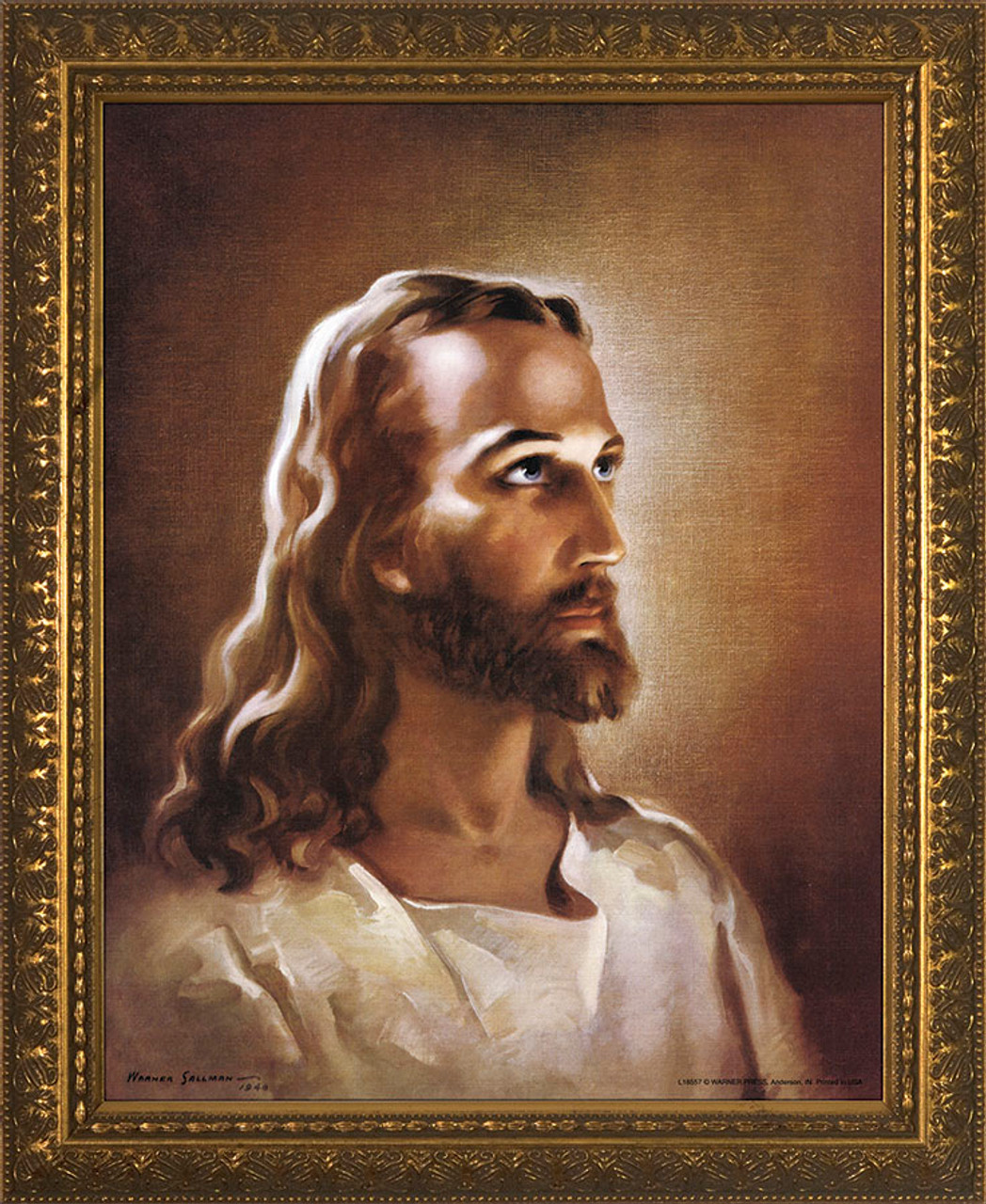
My father-in-law had a framed picture of Christ hanging in his home for years. He always hung it near the door and it was very precious to him. It looked a lot like this:

Now it is not my intent to pass judgment on whether my father-in-law was right or wrong in hanging this picture in his home. My intent is to get us thinking about how we use our minds when we read Scripture and to raise questions about the purpose of John’s visions of Christ in Revelation. I think A.W. Tozer was exactly right when he said, “What comes into our minds when we think about God is the most important thing about us” (The Knowledge of the Holy). There is a lot about God that we don’t understand, but the things he has revealed to us should occupy our minds in a way that leads us to worship. I believe this is the intent of John’s visions of Christ in Revelation.

What do you think? Do our artistic depictions of Christ unintentionally shrink him down to our size?

My Struggle with Productivity

I have a love hate relationship with the whole productivity industrial complex. Why do I call it that? Because it’s a thing. You see it all over social media and the publishing world. How to maximize time. How to get things done most efficiently. This appeals to a lot of us, especially people like me who are prone to perfectionism. Mondays are the perfect day for me to plan, strategize and make lists. I love lists. On Mondays I usually make a list called a ‘Brain Dump’. This is where I just list everything I can think of that I want to get done in the week. It helps to download all of it onto paper.

But how does God see productivity? I have been asking myself these questions lately. Going back to school has added a lot to my list and the old perfectionism rears its head when I look at the syllabi for my classes filled with hundreds of pages of reading and parameters for research papers. How to get it all done? How can I schedule my day in a way to not get behind? What about all the other responsibilities in my life? Someone has to cook dinner and clean toilets after all.

The first class I took in seminary was called “Redemption Unfolded”. The class covered the overarching story of Scripture and while the subject matter made an impact on me, the teacher also left an indelible mark. He wasn’t a professor at the seminary, but a local pastor, and this was his first class. After introductions he had us read out loud the following Scripture and meditate on it silently:

Whatever you do, work heartily, as for the Lord and not for men.

Colossians 3:23

Work heartily? Yes! This was why I was in seminary. I was eager to work heartily, to read widely and deeply from authors I’d not been exposed to, to learn the original languages in order to peel back and expose the beauty and depth of God’s word, and to enjoy all kinds of theological conversations with my professors and classmates. But wait. There’s more to this command.

Work heartily as for the Lord and not for men. This is what cut me to the quick that day. The Holy Spirit put his finger so to speak on this area of my heart, this place that still needed to undergo his refining work. And this area is still under construction, two years later, as I make my way through another semester. This semester has been very difficult because of the added stress of caring for my aging parents and grieving the loss of my father-in-law. As I saw the amount of work in front of me, I began to panic, and I grasped for ways to perfectly organize my time and my assignments. Being organized is good, but panicking is not and the Lord showed me exactly where that panic was rooted – in idolatry. When I work heartily for man and not the Lord, I am motivated by grades and reputation. I get consumed with anxiety about what others will think if I don’t maintain a certain standard. Not only that, but what will I think about myself?

I don’t know all the answers when it comes to a faithful approach to productivity, but I have begun to recognize the traps that I fall into. One of those is the idolatry of achievement and reputation as I described above. The other is believing the lie that I am the master of time. If I could only organize each hour perfectly according to the priorities that I have established, then I could lay my head down on the pillow at night fully satisfied. But this mindset encourages us to live contrary to our natures as limited creatures. We are not master manipulators of the minutes of our lives. We are not God! And it also goes against how God sees growth and productivity in our lives. First of all, he is in charge. Yes, we are called to work out our salvation but that is rooted in and empowered by the work that God continually does in us for his good pleasure. (Phil. 2:12-13).

We are the clay and not the potter.

We are the branches and not the vine.

We are the sheep and not the shepherd.

Second, growth is slow. While we’re focused on speed and efficiency, God is calling us to learn from his creation about faithfulness and perseverance over a long period of time. Clay takes time to be molded by the careful and loving hands of the potter. Branches take time to develop and grow until the buds form and fruit appears. Sheep take time to learn their master’s voice and follow his commands. Think about how ridiculous it would be for the potter, the gardener, or the shepherd to stand over his work, hands on hips, impatiently crying out, “Will you just hurry up!” But we look at our lives, our children, and our work like this, as if everything could be microwaveable and should progress onward and upward in an unbroken line.

There’s a fig tree planted in my backyard. We planted it almost five years ago and it still hasn’t borne fruit. Last year it came close. As I observe the tree out of my kitchen window this spring, again putting out buds and then leaves, I think about the patience and kindness of God and I ask for wisdom. Wisdom to realize that I am not a machine but a limited creature who is dependent on the Lord for life, health and breath. Wisdom to see when my work becomes more about me and less about him and those I’m called to serve. With my mind renewed I can then reframe what productivity means. I’m coming to realize that it has much more to do with faith-filled patient work that bears fruit over the long haul.

Reading Revelation Aloud

Almost every night as I settle into bed I pull out my book light and a book and read until my eyelids get heavy. Silent reading seems second nature to us and essential to every day life, but did you know that this is a rather new practice and something that used to be frowned upon? For hundreds of years, reading was a communal activity where people would gather to hear someone else read aloud. It was a shared activity with others who may have been illiterate but also didn’t have access to scrolls or books. With this in mind, look at the blessing that is proclaimed in the first chapter of Revelation:

Blessed is the one who reads aloud the words of this prophecy, and blessed are those who hear, and who keep what is written in it, for the time is near.

Revelation 1:3

There is a blessing here for those who read aloud, for those who hear, and for those who keep the words of this prophecy. Focus on the first descriptor – those who read aloud. Some of us have heard portions of this book read aloud. How many of us have heard the whole book read aloud? How many of us have read it aloud ourselves? The original audience would have likely heard the whole book read to them out loud. What was that experience like? More on that at the end of this post.

Last summer I took a day to get away and fast and pray and part of that time I devoted to reading the whole book of Revelation aloud. Granted, this is probably not the way John meant it to be read aloud – one person, by themselves and to themselves. But this is the only book of the Bible that proclaims a blessing on those who read it, and read it aloud. Because of the length of the book and the intensity of the language, I had been intimidated to do it. I didn’t want any distractions or feelings of self-consciousness. But now was the perfect time.

What was my experience? Was I blessed? What constitutes a blessing? Is it a rush of emotion, a spiritual high? Is the blessing something that comes not instantaneously but over a long period of time? I don’t know all the answers to those questions yet and I still have a lot of studying to do in this book, but here are my first impressions.

A Thrilling Ride

Revelation is in the genre of apocalyptic literature which is very important if we are to read it and understand it for all its worth. This kind of literature was well known to the original audience but us moderns can be uncomfortable with the imagery and symbolism, trying to fit every piece of this puzzle into its proper place. Reading it out loud forced me to move faster through all the parts that confused me and as I did that I began to appreciate the thrill of it. There’s a roller coaster at Six Flags over Georgia called Goliath. This hypercoaster reaches speeds of up to 70 mph, but what is most thrilling is the steep climbs followed by precipitous drops paired with the restraints on the seats that don’t seem to be enough for what you’re about to experience. As you crest the hills you can look off to the west and see the Atlanta skyline before the drops force you to rise out of your seat as you plummet down. The tracks of the coaster go outside the park at one point completely disorienting you. But suddenly, you arrive at the end, breathless and wondering whether you should go again.

Revelation is a literary roller coaster, taking you to the heights of heavenly worship then immediately plunging you to the depths of man’s depravity and the coming judgment on Satan and those who worship the Beast. This happens several times over the course of the book, telling us the same story from different angles, until at last you get to the wedding feast of the Lamb and the glorious New Jerusalem. By the end of my reading I was left breathless and in awe of God. I wanted and needed to read it again.

A Humbling Experience

One of the temptations we all face in this world is to shrink God down to our size while at the same time inflating our own egos and importance. Revelation will have none of that. From the beginning vision John has in chapter 1 of the glorious son of man with eyes like a flame of fire and a voice like the roar of many waters, we are encouraged to see ourselves rightly and take our place with John humbly worshiping at the feet of the Lord.

As John gets whisked up to the throne room of heaven by the Spirit, we get a vision of who the hero of this book is. It is not us. Yes, the Lord desires to see his church witness faithfully and endure patiently through every trial on this earth. And there are glorious rewards promised for those who overcome. But we have not written the script and we are not worthy to open the seals. We don’t overcome by clever church growth strategies or by “taking back America” (whatever that means). We overcome by the blood of the Lamb and the word of our testimony having loved not our lives even unto death. (Rev. 12:11)

A Sobering Experience

Many people are scared to read this book. The imagery of the beast and the false prophet, the dramatic visions of judgment and the picture of the church suffering for their witness of Christ makes people afraid for their own salvation and for their children’s futures. They would rather be raptured out of all of it! But as I read the book out loud that day and have continued to read or listen to it being read, it has had the effect of downing a strong cup of coffee or being splashed in the face with ice cold water.

If the events of this book are describing the experience of the church throughout what’s called the inter-advent period (between the ascension and the second coming of Christ) from the perspective of heaven, then we should not be surprised by, for example, Christ’s words to the rather wealthy church in Sardis – “Wake up!” Perhaps the over the top imagery of this book is John’s way, and God’s way, of changing our perspective, not so we would fear, but that we would look at the world around us through the right lens, being equipped and prepared to endure.

Read This Book!

I highly recommend reading this book out loud, preferably in your church or another group setting. Imagine how it must have felt being an original recipient of this message. Perhaps you were a member of the church in Smyrna, poor (but rich in God’s eyes!) and about to suffer severe trial, or maybe Laodicea, at ease and rich but sorely deceived about your true spiritual condition. Christ had a message just for you. He knew your works, he was walking among you, and offered encouragement, rebuke, and a promise of reward for those who overcame.

Many scholars believe that these seven churches represent the whole church throughout history. If this is so, then we should also take to heart Christ’s words. He speaks them as the Lamb who alone is worthy to open the seals, who is the faithful witness and ruler of kings on earth. He has given us the true story of the world and how we are to endure patiently as those who are the much-loved, blood-bought kingdom of priests to our God.

Reading this book will be difficult, but in all the best ways. Yes, it will confuse you. It has confused the church for many centuries and no one has unlocked every truth contained in it. But remember, the promised blessing is not for those who understand Revelation but for those who read and hear and keep what is written in it.

The time is near! So join me for this thrilling, humbling, and sobering journey through the book of Revelation.

Come to Jesus

We all would admit we need to pray more. It sounds spiritual and convicting. And sometimes it is. Many of us, from time to time, need a good swift kick in our spiritual backsides. But more often than not, at least in my case, what I mean when I say I need to pray more isn’t at all spiritual. It looks like a frantic and anxious digging around in my flesh, all upset and guilty that I don’t look as shiny as I want to. No wonder. When we look at ourselves and to ourselves, we see a wasteland of weakness and unmet expectations.

When you read John’s gospel you see that Jesus is calling people to a life of belief. The next time you read John, pay attention to how many times the word ‘believe’ is used. It’s everywhere. But what does believing mean?

Believing means coming to Jesus.

Believing isn’t just a one time thing. It’s continuous. If it weren’t, Jesus wouldn’t have described himself as the living bread which we are invited to feed upon forever. (John 6:48-58) Nor would he have swung wide the invitation to come to him and drink from the living water. (John 7:37-39)

Why would Jesus equate belief with eating and drinking? Just like we need to keep eating and drinking to sustain ourselves physically, we need to keep believing, keep coming to Jesus to sustain ourselves spiritually. What is fed in the act of believing is not the body, but the soul — our deep soul-hunger is satiated and our never-ending soul-thirst is quenched when we come to Jesus.

John Piper, in a sermon on John 6 explains this well when he says:

Believing is not even a state of satisfaction in Christ or a state of pleasure in Christ. Rather, John wants to emphasize that we never put down the cup of living water, as though we’d had enough. We never lay aside the loaf of heaven’s bread, as though we were stuffed. “Believing” doesn’t do that. Believing is receiving constantly, and coming constantly. Christ is ever giving himself as drink and food for our souls. We are ever putting our lips to the cup, and our tongue to the bread. Life in Christ is like a branch in a vine, not like a full cup sitting on a table beside a full pitcher. “I am the vine; you are the branches. Whoever abides in me and I in him, he it is that bears much fruit” (John 15:5). Believing is what a branch does in the vine. It drinks. It eats. It never stops. It abides. Forever.

Belief in Jesus isn’t something I did once upon a time in December of 1991 when I was converted. Belief is the continual coming to Jesus and finding in him everything I need. If I see a lack in my own life, it makes no sense to search for the answer in myself. But in Christ there is an infinite and free reservoir of grace and mercy. We should not be ashamed to come to him. He freely invites us to partake of these riches.

“Let us then with confidence draw near to the throne of grace, that we may receive mercy and find grace to help in time of need.” Hebrews 4:16