Sanctification as Remembering

Soul tightening.

I came up with that last year at this time. It described how certain concerns and anxieties came creeping into my soul and kept me from breathing deeply of his grace.

Yesterday I was reminded of Galatians 5 and freedom. When we don’t stand fast in that freedom the result is a falling from grace.

Grace, freedom. Remember.

Remember that going back to the law is going back to slavery. Going back to a master that has only one message. Condemnation.

Just as the Israelites were called to remember, I must remember. Remember the promises of grace and remind myself of my weaknesses.

We all have certain strains of weaknesses, like ruts in the dirt road that we’re prone to fall into.

That tightening of the soul came back this week. I had an unexpected day off on Wednesday and I contemplated what to do. And I felt my soul tightening as I questioned my choice of activities. Back and forth, what was right for that day? Shouldn’t I spend time with this person or that person? I shouldn’t be selfish and just do what I want, right?

I didn’t see that rut coming. I fell right into it.

Paralyzing introspection.

I didn’t realize I was in the rut until the next day. I had been oblivious to this weakness of mine.

To climb out I needed to remember. I needed to remind myself that the opposite of paralysis is freedom and the opposite of introspection is looking to Jesus.

Remembering my weaknesses and my need and the promises already in my possession will help me stand in that gracious freedom and will result in greater sanctification.

Word vs. Spirit? Calvin’s Institutes 1.9

Many today would say they are spiritual but have nothing to do with God’s word.

“Those who, rejecting Scripture, imagine that they have some peculiar way of penetrating to God, are to be deemed not so much under the influence of error as madness.”

Calvin pulls no punches. He makes the point that to call oneself spiritual without any reference to God or his word is crazy, because what spirit is guiding them? Some may feel they are being more open and generous to say they are spiritual apart from the Bible, but what spirit are they opening themselves up to?

Christians are tempted by this as well. We may stray from the written word and think that experiences of the Spirit are paramount.

“But they say that it is insulting to subject the Spirit, to whom all things are to be subject, to the Scripture: as if it were disgraceful to the Holy Spirit to maintain a perfect resemblance throughout, and be in all respects without variation consistent with himself.”

John 16:13 says that the Spirit never speaks of himself. The doctrine of the Trinity describes a three-in-one God who is perfectly harmonious within himself. Why then do we long for a spirit that is unconstrained and free, without borders? The Holy Spirit, because he is part of the godhead must act in accordance with God’s nature, and therefore, with God’s word.

The Spirit and the word go together. The Spirit is not superior to the word. He administers and confirms the word.

“God did not produce his word before men for the sake of sudden display, intending to abolish it the moment the Spirit should arrive; but he employed the same Spirit, by whose agency he had administered the word, to complete his work by the efficacious confirmation of the word.”

Calvin warns at the end of the chapter of fastening onto random notions of our own minds.

“…the word is the instrument by which the illumination of the Spirit is dispensed.”

He says we are daily invited to experience the Spirit through the hearing and reading of the word. The Spirit administers and confirms and enlivens the word.

To put the Spirit at odds with the word or to seek him apart from the word is not to seek the true Spirit at all.

Meditation on 2 Samuel 22

“This God – his way is perfect…”

All around me and inside me I see imperfection, things left undone, words I shouldn’t have said. Every action, thought, word of God is perfection. There are no doubts, no mistakes in him.

“…the word of the Lord proves true…”

It’s not just that the word is true, but that it proves true. God has shown over and over that he will do what he says. Why do I think I am an exception to him fulfilling his promises? God speaks and will perform all his word. Ezekiel 12:25-28

“…he is a shield for all those who take refuge in him.”

He is a shield for those who do what? Take refuge. If you stand in front of the shield, you will not be protected. Hide yourself behind the shield. Hide yourself in him.

“For who is God but the Lord? And who is a rock, except our God?”

He alone is God. He alone is an unshakeable, unmoveable, unbreakable rock.

“This God is my strong refuge and has made my way blameless.”

I like the use of the word, this. Look here, behold, this God. Not that god, but this God, is my place of safety. He makes my way blameless.

Jude 24-25….

“Now to Him who is able to keep you from stumbling and to present you blameless before his presence with great joy, to the only God our Savior, through Jesus Christ our Lord, be glory, majesty, dominion and authority, before all time and now and forever. Amen.

Sinful Introspection

Today I was listening to a podcast about what we can learn from Jonathan Edwards.

I love Jonathan Edwards. I am especially drawn to his resolutions. When he was a young man he came up with 70 resolutions for his life. They are a die hard commitment to a God glorifying life. Years ago, after first reading his resolutions, I came up with my own. I am a rule follower at heart so this kind of thing was right up my alley.

In this podcast, two Edwards scholars were asked about their take on the resolutions and if Christians today should make up their own. I was surprised to hear their responses.

They said no. They said these resolutions came from a time in Edwards’ life when he was full of youthful zeal for the Lord. This isn’t bad but later on in his life, Edwards realized that this kind of youthful zeal could easily turn into a prideful legalism.

One guy on the podcast said that Edwards can come across with these resolutions as someone expecting himself to live this super heroic Christian life. Edwards realized later that he was guilty of a kind of overemphasized introspection. It caused him to judge himself very severely. As he went along in life, Edwards learned more about living by grace.

I am very prone to this overemphasized introspection. What is this? It is looking inwardly at yourself, taking a microscope to your attitudes and actions, constantly seeing if you’re measuring up.

This is not the gospel. If we are saved by grace, we must live by grace. Let’s not try to take on the Holy Spirit’s job. He has promised to finish what he started. Philippians 1:6

Calvin’s Institutes, Chapter 1

“…we cannot aspire to him in earnest until we have begun to be displeased with ourselves.”

How true. An honest assessment of our own selves reveals our need for him. Calvin further argues that if we only compare ourselves with what’s around us, we’ll never come to the truth. Only up against the blinding whiteness of his holiness do we see our corrupt pollution and our desperate need.

“…men are never duly touched and impressed with a conviction of their insignificance, until they have contrasted themselves with the majesty of God.”

The great need of the moment is to have clear vision, of ourselves and of God. This is true wisdom.

The Pride of Anxiety

To be anxious is to be proud. Anxiety lies to you. It tells you that you’re in control. It expects you to know everything. 
You’re supposed to be able to.

You’re supposed to know how.

Humility is content to accept limitations. Limitations of knowledge. Limitations of control.

John Piper has said that in any situation, God is always doing a thousand different things that we cannot see and do not know. God designed me to not have that vision or knowledge. 

To covet it is to go beyond my limitations into anxiety.

Anxiety then has roots. Roots of pride and covetousness.

Thanks go to Hannah Anderson and her book, Humble Roots, for the inspiration for this post.

What is Mortification

Here we are, back to our good friend John Owen. Coming back to this book is always good. It’s a soul-bracing activity actually. How easily do I give myself to the superficial, transient things of the world.

Owen is deep into the process of mortification and it’s good stuff. However, I think it would be helpful to remind ourselves of the truth of our union with Christ in regard to sin. We have been crucified with Christ and sin has no dominion over us (Romans 6). The decisive battle has been won and we are clothed with the righteousness of Christ. But until the consummation, we are still in this flesh, and we’re still engaged in skirmishing with this enemy. But be encouraged because we fight not for victory but from victory.

“Every lust is a depraved habit or disposition, continually inclining the heart to evil.”

Owen is not talking about sexual lust. He is talking about any sin. Any sin is distorted desire. Do we think this way? Probably not. And I know I don’t think of sin as continually inclining my heart to evil. Continually. The battle is ever ongoing.

“When, therefore, men have slight and transient thoughts of their lusts, it is no great sign that they are mortified….It is to be feared that very many have little knowledge of the main enemy that they carry about with them in their bosoms…To labor to be acquainted with the ways, wiles, methods, advantages, and occasions of its success is the beginning of this warfare.”

The beginning of this warfare, this struggle, is to have a knowledge of our enemy. College football coaches labor constantly to understand their opponent. They watch film, they draw up plays, they instruct their players. How much more should we understand the enemy that desires to lay waste to our souls? Do we understand our own weaknesses and how the world, the flesh and the devil scheme to destroy us?

Owen describes mortification as a continual weakening of sin. I think of it as trying to kill kudzu. Kudzu keeps coming back, and sin keeps rearing its ugly head. So how do we actually do this? Owen describes the foundation like this:

“the weakening of its indwelling disposition…by the implanting, habitual residence, and cherishing of a principle of grace that stands in direct opposition to it and is destructive of it, is the foundation of it.”

In other words, we must fight a particular sin with the opposite grace. Paul describes the process in Colossians 3. We must put off the deeds of the flesh, and put on the deeds of the Spirit. Put off pride, put on humility; put off anger, put on kindness; put off wrath, put on love.

The key for Owen is doing this by the Spirit. The temptation for me is to read these imperatives and to think I can go out all American-like and tackle this enemy in my own strength. No, no, no. Remember Romans 8:13 – “but if by the Spirit you put to death the deeds of the body you will live.”

An unbeliever has no hope of succeeding in this battle, but the believer is in the same boat if they try to fight with the arm of the flesh. The instrument in the battle is faith. Faith in Christ, faith in His promises.


How to Hide the Word

So how to start memorizing? I have already mentioned Janet Pope’s book, His Word in my Heart. Her method remains a key for my success in memorization. 

When your hands are busy but your mind is not, that is time you can redeem for Scripture memory.

So that solves the issue of when and where. Figure out how you can transform those mindless, daily tasks into times for Scripture memory. Over the years, my favorite times and places to memorize are in the shower, while drying my hair, and while driving. 

Here is Matthew 6, typed out and in a plastic sleeve. It sticks to the tile.

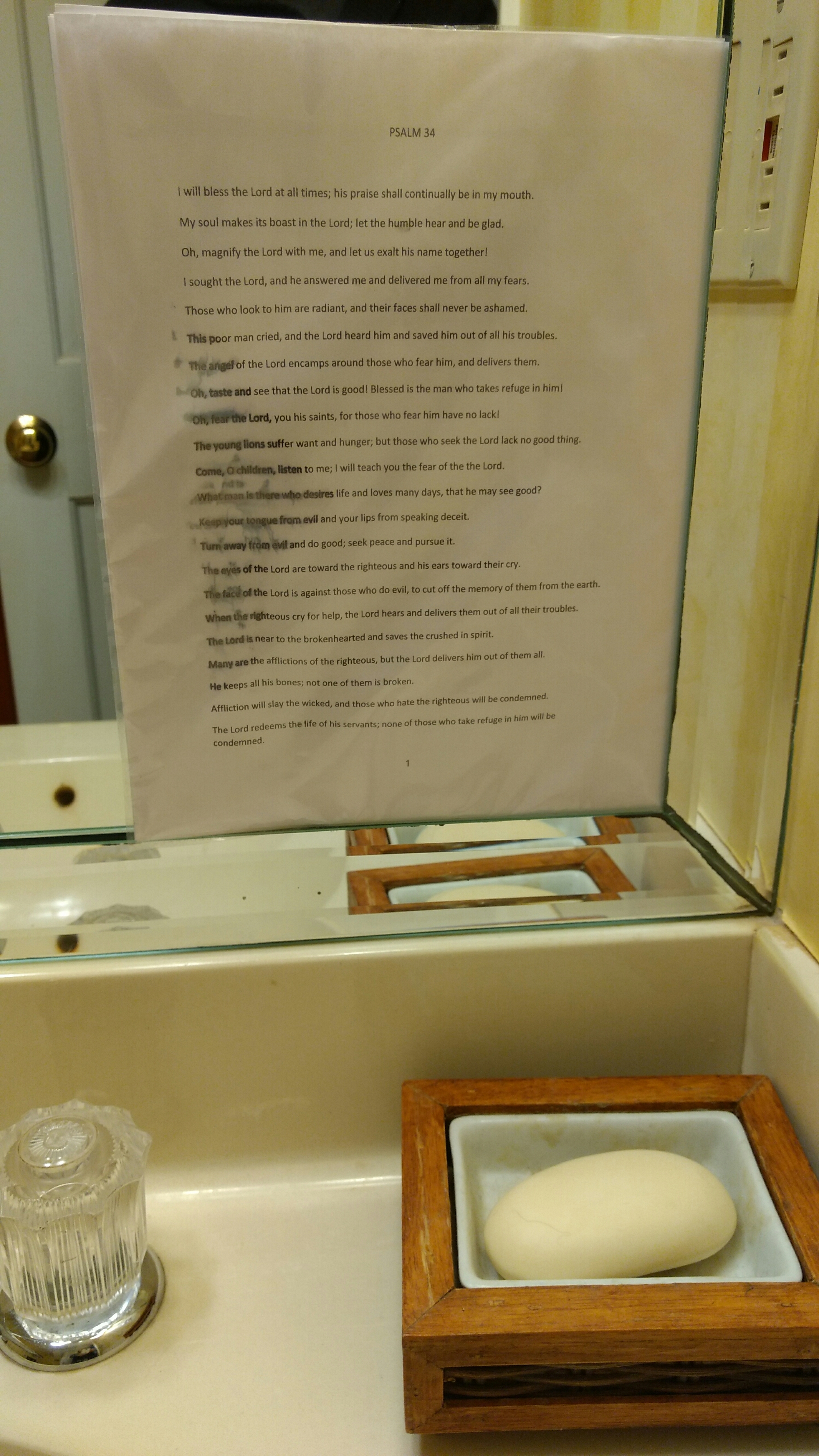
Here is Psalm 34, again in a plastic sleeve and tucked in the mirror. It got wet while in the shower!

This is a mini binder with Scripture typed up in plastic sleeves. I keep this in the car and review when it’s safe to do so. 😉 

How?

There are many tips and tricks to memorizing, but here are the ones that have worked for me:

1. Repeat the verse out loud ten times. Out loud is key. There is something about engaging more than one sense that helps you retain it.

2. Find patterns and make acronyms. I once listened to a story about people who competed in a national memory competition. A key for them was to come up with silly associations for what you are memorizing. Sounds like an extra step but it works! So if there is a list of things to memorize take the first letter of each and make a silly word.

3. Start with saying the first word out loud and then add one at a time and keep repeating what you have. For example, in Colossians 3 you would do this:

If

If then

If then you

If then you have

Etc., Etc.

4. Pray the Word. Learn it. Internalize it. This is the best tip because it accomplishes what you want in the end. You don’t want to just pile up verses and chapters and books in order to impress your friends and family. You want to delight in it and obey it and use it to gain intimacy with God. Memorizing whole Psalms is especially good for prayer.

5. Finally, review. And review. And review some more. This is the only way to make it stick. Have a plan to review certain passages on certain days, whatever works for you. Enlist friends to help you.

I hope this little series has inspired you to hide God’s Word in your heart. You will not regret implementing this habit. His Word does not return void.

I Hope in Your Word

“Do not be conformed to this world, but be transformed by the renewal of your mind…” Romans 12:2

“And we all, with unveiled face, beholding the glory of the Lord, are being transformed into the same image from one degree of glory to another.” 2 Corinthians 3:18 

I can’t think of a more powerful method of transformation than beholding the glory of the Lord in the Word. 

As I have memorized more and more Scripture, God has used it to transform me in many ways.

Prayer. The biggest change has occurred in my prayer life. Because I have memorized Psalms 103 and 23, I have instant access to words of praise that I can use in prayer. Memorizing Ephesians has given me large portions in chapters 1 and 3 that I can use to pray for others. But also, as I am praying and laying my requests and questions before the Lord, I have experienced time and again the Holy Spirit bringing Scripture to my mind that will counsel me and encourage me. This has been very sweet.

Thought life. All our minds wander. The plague of anxious thoughts can be relentless. It’s no wonder then that the Bible puts so much emphasis on the mind for transformation. We must be vigilant in patrolling the thoughts that enter. If I am in the habit of reviewing Scripture throughout the day, there is more room for transformation and less for wandering thoughts and anxiety. What fills our minds inevitably sinks into our hearts and drives our affections.

Bigger vision of God. Many of us have memorized selected verses here and there. I have found, though, that memorizing whole chapters and books has given me a bigger picture of who God is and who I am. Memorizing the opening greeting of Jude tells me I am beloved of the Father and kept for Jesus. Memorizing the beginning of Titus gives me a vision of a God who never lies and has been working out the promises of the gospel throughout all time.

Fellowship with the Holy Spirit. The more Scripture you hide in your heart, the more the Holy Spirit has to work with. What I mean by that is we have a part to play in sanctification. God is at work in us but we are called to work out our salvation with fear and trembling (Phil. 2). There have been many times when I’ve been reviewing a passage and can’t remember the next word and I pray and wait and then the Lord brings that word to mind. Or I am thinking of an issue and the Lord brings a pertinent Scripture to mind.

The Bible is not a dead letter. It is the living Word of the the very Word, Jesus Christ. 

Next time I will get into the nuts and bolts of memorizing, but for now watch this excerpt of a John Piper sermon.

Hiding His Word

If you have a desire to memorize Scripture how do you go about it? You may have doubts about your ability to do this. While there are some who memorize more easily than others, I am convinced that anyone can improve their memorization skills if they just keep at it. I know that over 8 years of consistent memorization, my abilities have improved. And please do not forget God in this. The Lord wants you to know his word and cherish his word in your heart. He will work in you to help you with this.

The Internet has an endless stream of advice on how to memorize and I could link to several sites. I won’t do that because I know from working with other people that each one finds their own method. We are all individuals with different learning styles and capabilities. I can only speak of my own experience and what has worked for me so please don’t think you need to copy me.

The woman who inspired me was Janet Pope. She wrote a book called His Word in My Heart. I heard Janet interviewed on Revive Our Hearts and was encouraged by her method. Basically, she suggests recapturing those moments of our day when we are doing repetitive tasks and instead use them to memorize Scripture.

Folding laundry, doing dishes, drying your hair, taking a shower, waiting in line at the store, waiting in the doctor’s office, waiting in carpool, etc. These are all moments we can recapture and repurpose for hiding God’s word.

In her book, Janet suggests starting small by memorizing Psalm 1. It’s only 6 verses. But I like a challenge so when I heard that Janet had memorized whole books of the Bible, I thought I’d start with a book, albeit a small one. I started with Jude. Only 25 verses. I started writing each verse on an index card and gradually added verses until I had the whole book.

The real key that unlocked the door though was developing the habit of taking those daily moments and repurposing them for memorization. That helped me to consistently review what I had already memorized so I wouldn’t lose it.

Do I do this perfectly? No. That’s not the goal. The goal is to transform and renew my mind and affections so I can know and love God more. Next time I will describe in greater detail that transformation.

For now, please watch this video of Janet Pope.